
Quick Answer
Domain authority is a search engine optimization metric developed by Moz that predicts how likely a website is to rank in search engine result pages on a logarithmic 1-to-100 scale. It primarily measures comparative backlink profile strength and quality across domains, rather than serving as a direct Google ranking factor or an absolute measure of content quality.
Understanding how search engines evaluate websites is a crucial component of modern digital strategy. While dozens of metrics exist to help business owners evaluate their online performance, few generate as much discussion—and frequent confusion—as domain authority.
Navigating the world of online metrics can easily feel overwhelming, especially when trying to discern which numbers truly impact your bottom line. Evaluating your online presence requires separating high-value optimization signals from third-party scoring metrics. This reference guide provides a clear, practical breakdown of what authority metrics evaluate, what they overlook, and how to use them effectively to grow your business with confidence.
What Is Domain Authority and How Is It Calculated?
Domain authority (DA) is a comparative prediction metric created by search marketing software companies—most notably Moz—to estimate how competitive a root domain is in search engine rankings. It is calculated on a logarithmic 100-point scale, meaning advancing from a score of 20 to 30 requires significantly less effort than moving from 70 to 80.
In practice, a domain authority score is not a fixed grade or a final report card, but rather a relative benchmark. Because the scoring algorithm evaluates billions of web pages simultaneously, individual scores can fluctuate even when a website makes no structural changes, simply because other sites in the global index gained or lost backlinks.
How does a domain authority checker calculate scores?
A domain authority checker evaluates a website by running its backlink profile through a predictive machine-learning algorithm. The tool analyzes dozens of distinct signals, focusing heavily on total referring root domains, external link quality, and overall link diversity.
When you run your URL through a third-party domain authority checker, the engine compares your backlink data against thousands of search results across various industries.
Domain authority functions primarily as a comparative diagnostic tool rather than a final judgment of your website's search value. Evaluating your score against direct competitors yields far more practical value than chasing an arbitrary target score.
What is the difference between domain authority and page authority?
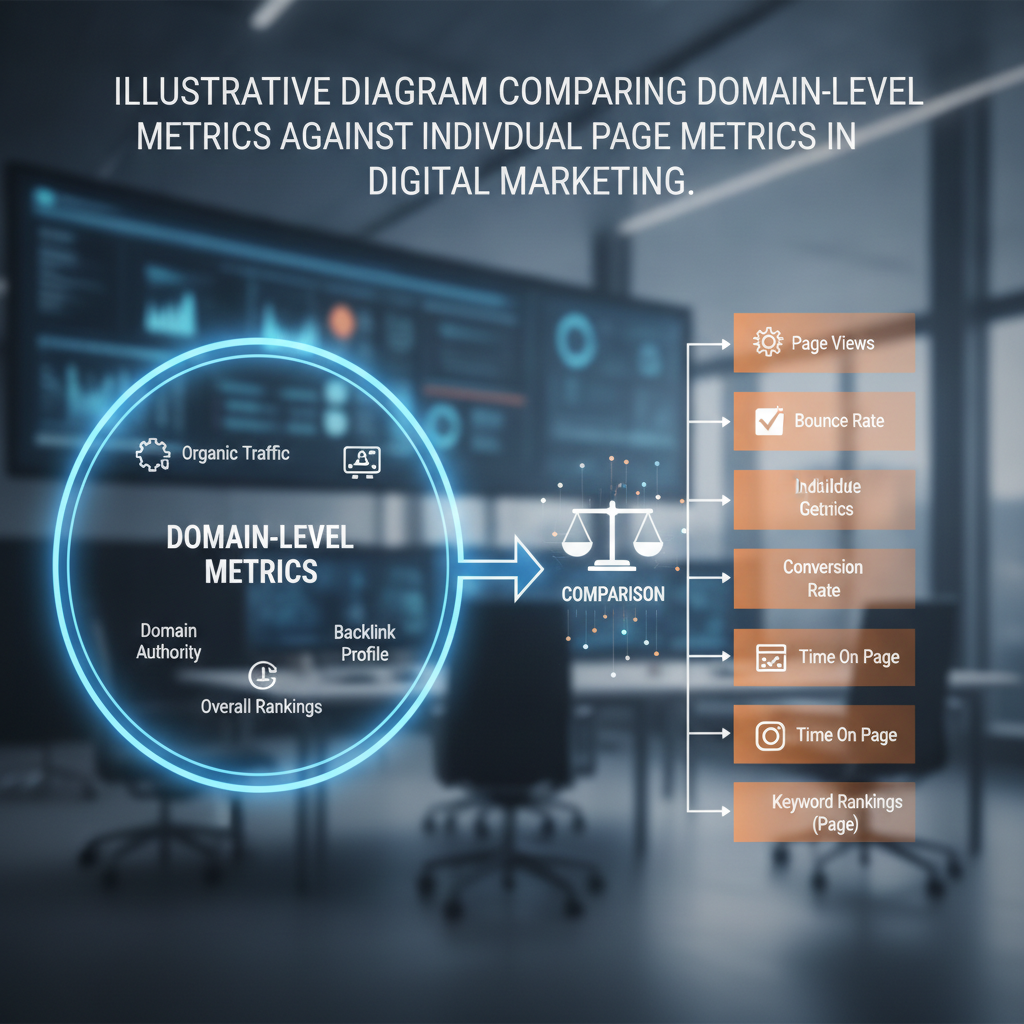
While domain authority measures the predictive ranking strength of an entire root domain or subdomain, page authority measures the strength of a single individual URL.
Domain Authority: Evaluates the aggregate strength of all external links pointing to your overarching web domain (e.g., `yourbusiness.com`).
Page Authority: Measures the specific link weight and ranking likelihood of a single page (e.g., `yourbusiness.com/services`).
A website may possess a moderate overall domain score while maintaining specific high-performing pages that achieve high page authority scores due to concentrated, high-quality inbound links and thoughtfully optimized content.
📊 Average Domain Authority Benchmark by Website Maturity Tier
What Does Domain Authority Actually Measure?
Domain authority serves as a proxy for link-based popularity and trust. Based on real-world results across client portfolios, websites with higher scores generally possess broader backlink networks, making them more resilient when targeting highly competitive search phrases.
What specific factors influence your DA score?
Third-party authority algorithms prioritize several key link-related metrics:
- 1Total Unique Referring Domains: The number of distinct websites linking back to your domain. Receiving ten links from ten different reputable sites provides significantly more authority than receiving ten links from a single site.
- 2Quality and Trust of Referring Sites: Links originating from established, highly trusted sites transmit greater weight than links from newer, unverified portals.
- 3Link Diversity: A natural mix of follow and nofollow links, editorial links, and varied anchor text signals an authentic backlink profile.
Why does a higher score not automatically mean higher rankings?
A common scenario business leaders encounter involves wondering why a competitor with a lower score outranks them for a target search term. This occurs because search engines like Google use over 200 distinct ranking factors—including search intent alignment, technical accessibility, and user interaction signals—which third-party DA scores do not evaluate.
Search engines reward relevance and helpfulness above raw metric scores. If a page with a lower score provides a more comprehensive, empathetic answer to a user's query, it will consistently outrank a high-authority domain that offers superficial information.

What Does Domain Authority NOT Measure?
To build an effective online presence, it is equally important to understand the limits of domain authority metrics. Focusing exclusively on score inflation can divert valuable time and resources away from foundational website improvements that directly benefit your visitors.
Is domain authority a Google ranking factor?
Domain authority is not a Google ranking factor, nor is it endorsed or used by Google. Officials from Google Search Central have repeatedly confirmed that Google’s algorithm does not use third-party authority scores to determine search results.
ℹ️ Info
Key Distinction: Google utilizes its own proprietary systems—historically rooted in algorithms like PageRank—to evaluate link equity and site trust. External DA checkers attempt to estimate these signals, but they operate independently of search engine algorithms.
How do user experience and technical performance fit in?
Standard domain authority checkers focus primarily on backlink parameters. Consequently, they do not account for critical user experience metrics, such as:
Core Web Vitals: Page loading speed, visual stability, and interactivity scores.
On-Page Content Quality: Depth of expertise, factual accuracy, and semantic content coverage.
Technical Health: Crawlability, indexability, mobile responsiveness, and clean site architecture.
User Engagement: Bounce rates, time on page, and direct conversion rates.
A website can achieve a high authority metric while delivering a frustrating user experience, but it will ultimately struggle to maintain top rankings if human visitors leave unsatisfied.
📉 Typical Domain Authority Trajectory for New Business Domains (Months 1-24)
How Can Business Owners Benchmark and Improve Their Metrics Responsibly?
Rather than viewing your score as a high-stakes grade to maximize at all costs, treat it as a supportive guide to help you understand your competitive landscape.
Attempting to shortcut authority growth through link-purchasing schemes or low-quality directory spam often triggers search engine penalties, damaging your search visibility regardless of what third-party metrics display.
What constitutes a "good" domain authority score?
A "good" score is entirely relative to your specific niche and local market.
In practice, local service businesses often dominate their geographical service areas with scores between 15 and 30, provided their local optimization and customer reviews are strong. Conversely, national enterprise software companies may require scores above 60 to compete for broad commercial keywords.
What actionable steps sustainably improve your site's authority?
To grow your site's overall authority and search performance naturally, focus on foundational digital practices that serve real human needs:
- 1Publish Authoritative, Original Content: Create insightful research, comprehensive guides, and practical tools that naturally encourage industry peers to cite and link to your work.
- 2Earn Local and Industry Editorial Links: Participate in community initiatives, join accredited professional associations, and contribute expert commentary to reputable publications.
- 3Audit and Maintain Link Health: Periodically review incoming links to identify toxic spam patterns, disavowing unnatural links when necessary to protect your domain reputation.
- 4Optimize Internal Link Architecture: Ensure that link equity earned by your top-performing pages flows efficiently to high-value conversion pages through descriptive internal hyperlinks.
Key Takeaways
Domain Authority is a relative index: Developed by third parties like Moz to predict comparative ranking potential on a 1-to-100 scale.
It is not a direct ranking factor: Google does not use third-party DA scores in its ranking calculations.
Backlink quality drives the metric: Scores reflect link quantity, quality, and domain diversity rather than page speed or user experience.
Context matters: Benchmark your score against direct market competitors rather than chasing universal numeric targets.
Navigating Search Growth with Clarity and Confidence
Building a strong digital footprint should empower your business, not leave you feeling overwhelmed by complex industry jargon or changing scores. While metrics like domain authority offer helpful diagnostic context, your real success comes down to delivering authentic value to your audience and establishing genuine online trust. When you focus on technical reliability, expert content, and meaningful relationships, sustainable rankings naturally follow. Connect with our team today to start an honest conversation about clarifying your digital goals and building a search strategy tailored around your business's true potential.
