
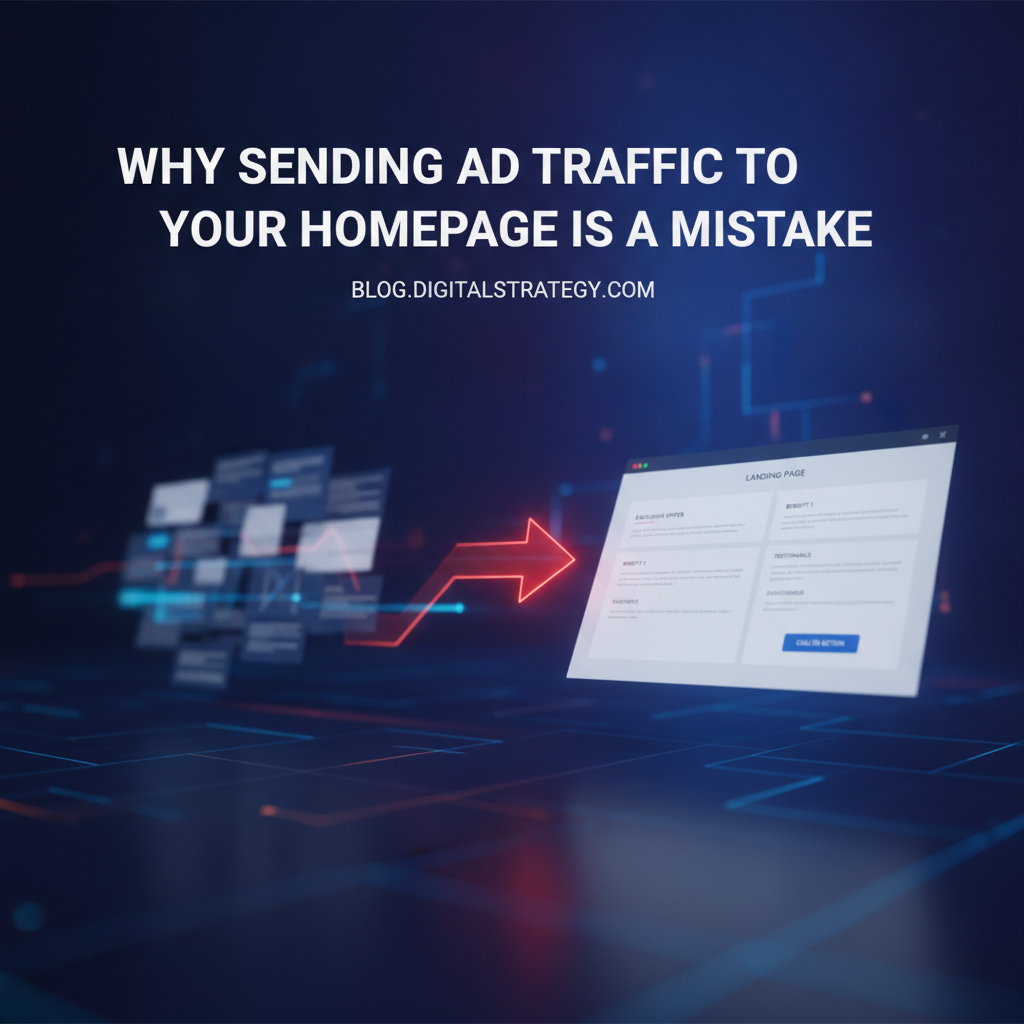
Quick Answer
Sending ad traffic to your homepage is a major mistake because homepages offer too many distractions, significantly lowering conversion rates. A dedicated ppc landing page aligns directly with ad copy, dramatically increasing Quality Score metrics and lowering your cost-per-click. Directing users to a targeted landing page for ads ensures visitor intent immediately matches your primary offer.
When you run a paid advertising campaign, every click costs real money. Yet one of the most frequent setup errors in digital marketing is routing that hard-won traffic straight to a company homepage.
While your homepage serves as an excellent digital storefront for broad audience discovery, it is rarely built to convert pay-per-click (PPC) traffic into paying customers or qualified leads.
Why is sending PPC ad traffic to your homepage a mistake?
Directing paid ad traffic to a homepage fails because homepages are designed for general exploration rather than specific conversions. When users click a targeted ad, they expect an immediate continuation of the exact product, service, or promise featured in that advertisement.
How does generic content decrease ad conversion rates?
Generic homepage content decreases conversion rates by forcing visitors to hunt for the specific information that prompted their click. Homepages cater to multiple audiences simultaneously—job seekers, investors, existing customer support users, and prospect buyers—which dilutes the focus required to close a sale.
In practice, when a prospect clicks an ad for "enterprise accounting software" and lands on a corporate homepage talking broadly about general financial management, friction increases. The prospect must navigate drop-down menus to find what they wanted. According to performance benchmarks across industries, sending paid traffic to dedicated pages yields significantly higher conversion rates compared to general homepages.
📈 Average Conversion Rate by Ad Destination (Industry Benchmarks)
"When you pay for every single click, sending a visitor to a general homepage is like handing them a map of a city when they just asked for directions to one specific store."
What impact does homepage navigation have on user bounce rates?
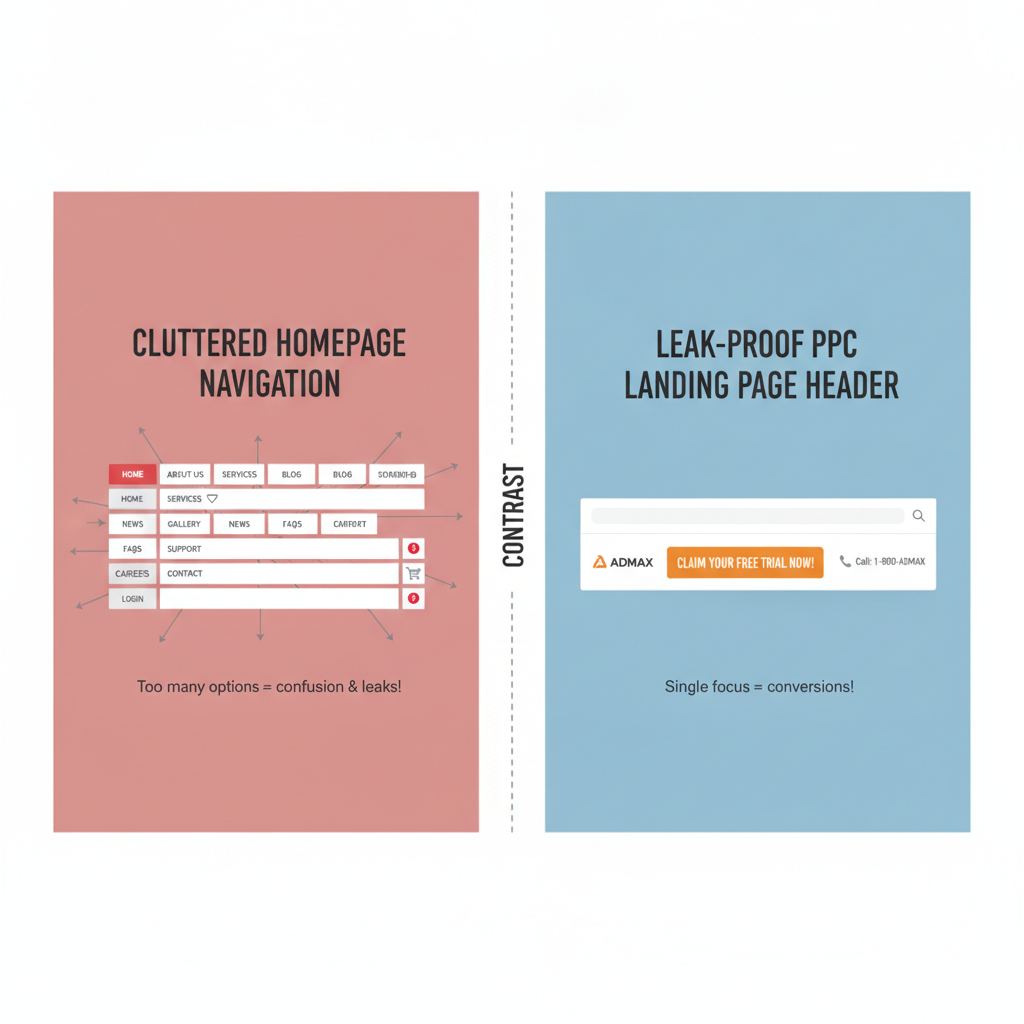
Excessive navigation links on a homepage dramatically increase user drop-off by presenting too many competing choices. The phenomenon known as Hick's Law proves that the time it takes to make a decision increases with the number and complexity of choices.
A standard homepage often features 20 to 50 clickable links across navigation headers, footers, social media icons, and blog callouts. Each link provides an escape route away from your primary conversion goal.
🥧 Where Paid Homepage Traffic Actually Goes
How do dedicated landing pages improve paid search performance?
Dedicated landing pages improve paid search performance by establishing tight alignment between the user's search query, the ad text, and the destination page content. This alignment optimizes key performance indicators across ad networks like Google Ads and Microsoft Advertising.
How does ad relevance affect your Google Quality Score?
Ad relevance directly dictates your Quality Score in Google Ads, which determines both your cost-per-click (CPC) and overall ad position. Google Search Central documentation highlights that landing page experience—including relevance, clarity, and ease of navigation—is a primary component of campaign evaluation.
When your ad keyword, ad copy, and destination page text share identical terminology, search engines award high Quality Scores (typically 8 to 10 out of 10). High Quality Scores earn higher ad placements while reducing your actual cost per click by up to 50%. Conversely, sending traffic to a broad homepage often results in low relevance ratings, inflating ad spend without driving results.
ℹ️ Info
Pro Tip on Quality Score: Google evaluates landing page experience based on transparency, ease of navigation, and keyword continuity. A targeted landing page built around a single keyphrase cluster will almost always outperform a multi-topic homepage in automated auction scoring.
Why does message match matter for paid traffic?
Message match is the alignment between the copy, visual tone, and call-to-action (CTA) of an ad and its corresponding landing page. Strong message match reassures visitors that they arrived at the correct place after clicking.
A common scenario we encounter involves a promotion promising "Get 20% Off Your First Order." If the user clicks that ad and lands on a homepage with no mention of the 20% discount, trust is instantly lost. A dedicated landing page for ads explicitly repeats the headline promise, reinforcing user intent and guiding them straight to checkout or form submission.
What are the essential elements of effective PPC landing page design?
High-converting ppc landing page design relies on a clear visual hierarchy, minimal friction, and a single, focused conversion path. Removing unnecessary distractions ensures every element serves the primary campaign goal.

How should you structure high-converting call-to-action buttons?
High-converting call-to-action (CTA) buttons must be visually prominent, benefit-driven, and positioned above the fold. Rather than relying on generic labels like "Submit" or "Learn More," strong landing pages use action-oriented language reflecting immediate value (e.g., "Claim Your Free Audit" or "Start Free 14-Day Trial").
To optimize CTA placement:
- 1Position the primary form or CTA button within immediate view without scrolling.
- 2Maintain high visual contrast between the CTA button and the background.
- 3Repeat the primary CTA further down the page for users who read supporting details.
- 4Eliminate secondary CTAs that compete with the main conversion objective.
What role does mobile responsiveness play in ad campaign ROI?
Mobile responsiveness directly dictates landing page conversion efficiency because over 60% of paid search traffic originates on mobile devices. A page that loads slowly or requires pinch-to-zoom on a smartphone leads to immediate user abandonments.
Key technical requirements for mobile ppc landing page design include:
Sub-2-Second Load Speed: Page performance degrades rapidly for every additional second of delay.
Thumb-Friendly Input Fields: Form inputs must be large enough to complete easily on small touchscreens.
- Simplified Layouts: Content should stack cleanly in a single column without horizontal scrolling.
"If your mobile landing page takes longer than three seconds to load, you are essentially throwing away half of your paid ad budget before visitors even see your headline."
Summary: Homepage vs. Dedicated PPC Landing Page
Choosing between a homepage and a dedicated landing page comes down to matching campaign intent with destination functionality.
| Feature / Metric | Homepage | Dedicated PPC Landing Page |
| --- | --- | --- |
| Primary Objective | General brand introduction & discovery | Single conversion goal (leads/sales) |
| Navigation Options | Extensive menu bar & internal links | Minimal to zero external links |
| Message Match | Broad corporate messaging | Tailored copy matching ad headline |
| Conversion Rate Benchmark | 1% – 2% average | 5% – 15%+ average |
| Google Quality Score | Typically low to average (4-6) | Typically high (8-10) |
By replacing generic homepage destinations with dedicated, single-purpose landing pages, campaigns benefit from higher Quality Scores, reduced acquisition costs, and maximum ROI from every ad dollar spent.
Bridge the Gap Between Your Paid Ads and Genuine Customer Growth
Running paid campaigns takes time, capital, and vision. Every click represents an actual person actively searching for a solution your business offers. When you guide visitors to a landing page created specifically for their needs, you respect their time, establish immediate trust, and safeguard your advertising investment.
If you are tired of watching valuable paid traffic wander away from a busy homepage without taking action, let us help you craft focused, frictionless landing page experiences that honor your audience and drive measurable results. Connect with our team today for a comprehensive campaign destination review, and make every ad dollar count.
