
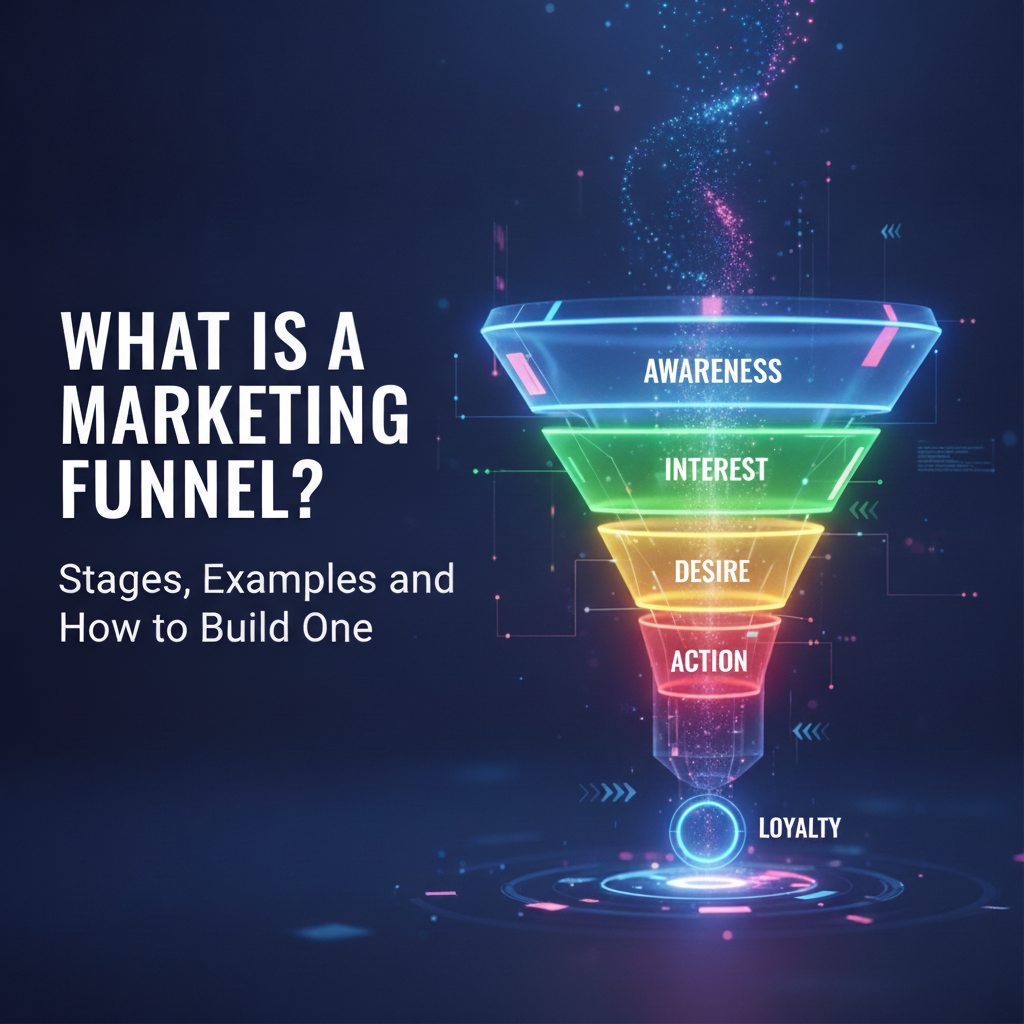
A marketing funnel is a strategic framework that maps out the complete customer journey, from the moment a prospect first learns about a brand to the point where they make a purchase decision and become a repeat advocate. By categorizing buyer behavior into distinct stages, business owners can systematically deliver the right message at the right time, thereby maximizing lead conversion and driving sustainable revenue growth.
ℹ️ Info
Quick Answer: A marketing funnel represents the conceptual path a prospective client travels from initial brand discovery (Top of Funnel) through evaluation (Middle of Funnel) to final purchasing action (Bottom of Funnel). Implementing a structured funnel helps small and mid-sized businesses capture qualified traffic, cultivate trust, and convert leads into long-term clients with measurable efficiency.
What Is a Marketing Funnel and How Does It Work?
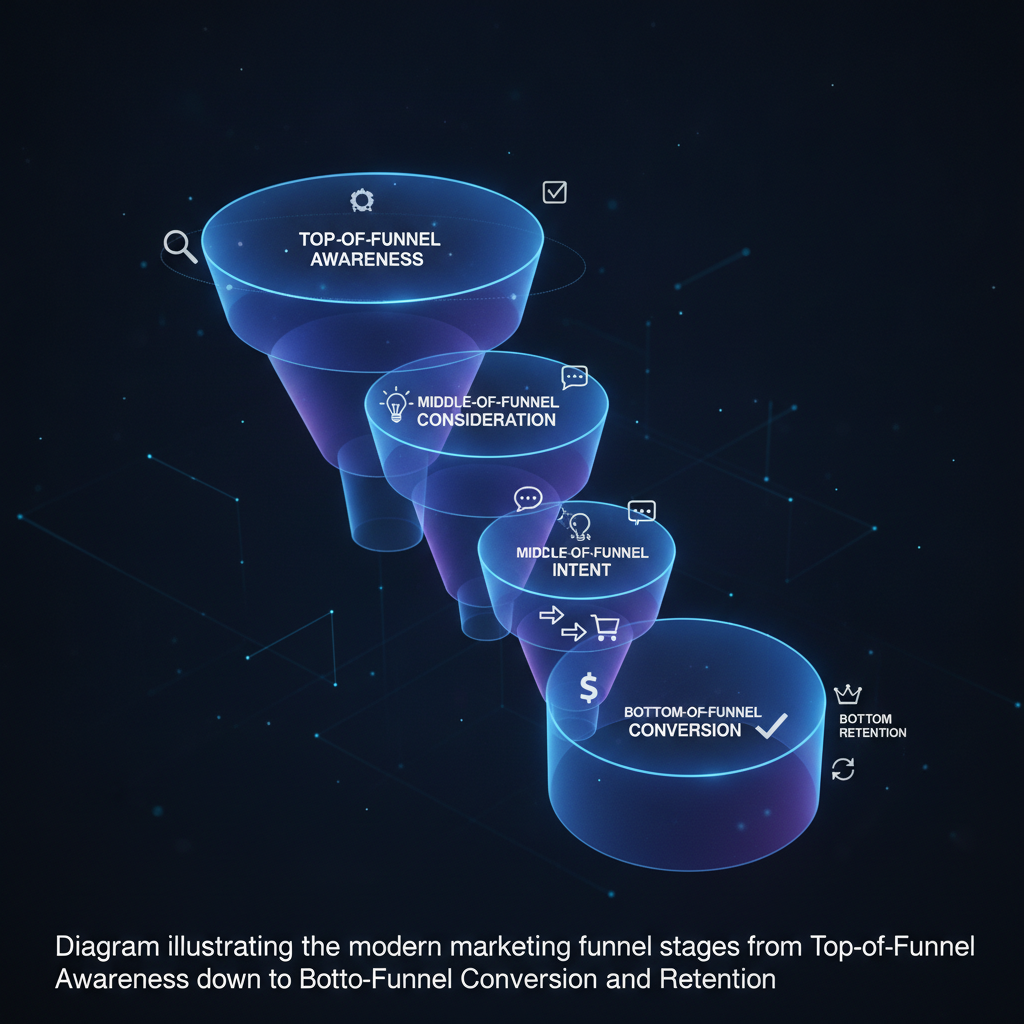
A marketing funnel is an analytical model that visualizes how potential buyers progress through various phases of engagement before completing a transaction. The shape of a funnel is intentionally wider at the top and narrower at the bottom, reflecting the reality that a large volume of initial traffic will naturally filter down to a smaller, highly qualified cohort of buyers.
In practice, funnel marketing replaces unstructured promotional tactics with a sequential system. Rather than attempting to sell a service immediately to a cold prospect, a well-engineered funnel establishes credibility first. It systematically addresses prospective client pain points, demonstrates industry expertise, and provides clear pathways for conversion.
What Is the Difference Between a Marketing Funnel and a Sales Funnel?
While the terms are frequently used interchangeably, a marketing funnel and a sales funnel address distinct phases of the customer acquisition lifecycle:
Marketing Funnel: Encompasses all activities designed to generate brand awareness, attract site traffic, educate prospects, and generate qualified leads. It operates primarily in the upper and middle stages of the journey.
Sales Funnel: Focuses specifically on the lower stage of the journey, taking qualified leads generated by marketing efforts and guiding them through direct communication, proposals, quotes, and contract execution.
In modern business environments, these two systems must integrate seamlessly. Marketing campaigns prepare and qualify leads so that sales conversations take place with informed, high-intent prospects.
Why Is the Customer Journey Structured as a Funnel?
The customer journey follows a funnel structure because consumer behavior inherently involves filtration. Research by Google Search Central on buyer intent highlights that consumers conduct extensive informational queries before displaying transactional intent.
As prospective clients conduct research, some will discover that a specific service does not match their criteria, budget, or timeline. Consequently, audience volume decreases at each progressive stage, while the buying intent of the remaining audience increases substantially.
🥧 Recommended Budget Allocation Across Funnel Stages
What Are the Stages of a Modern Marketing Funnel?
The modern marketing funnel typically consists of four core stages: Awareness, Consideration, Conversion, and Retention. Managing each phase requires distinct messaging strategies, media channels, and performance indicators.
```
/ \ Top of Funnel (TOFU): Awareness & Discovery
/ \ - Educational Content, Search Visibility, Social Reach
/-----\
/ \ Middle of Funnel (MOFU): Consideration & Evaluation
/---------\ - Case Studies, Solution Guides, Comparison Assets
/ \
/-------------\ Bottom of Funnel (BOFU): Conversion & Decision
/---------------\ - Consultation, Demos, Direct Offers, Proposals
| |
|-----------| Post-Funnel: Retention & Advocacy
- Onboarding, Loyalty Campaigns, Referral Programs
```
Top of the Funnel (TOFU): Awareness and Discovery
The primary objective of the Top of the Funnel (TOFU) is to introduce your brand to a broad yet relevant audience. At this stage, prospective clients are experiencing a specific problem or recognizing a need, but they may not yet be aware of available solutions or your specific firm.
Prospect Intent: Informational and educational. Buyers are searching for definitions, explanations, and industry insights.
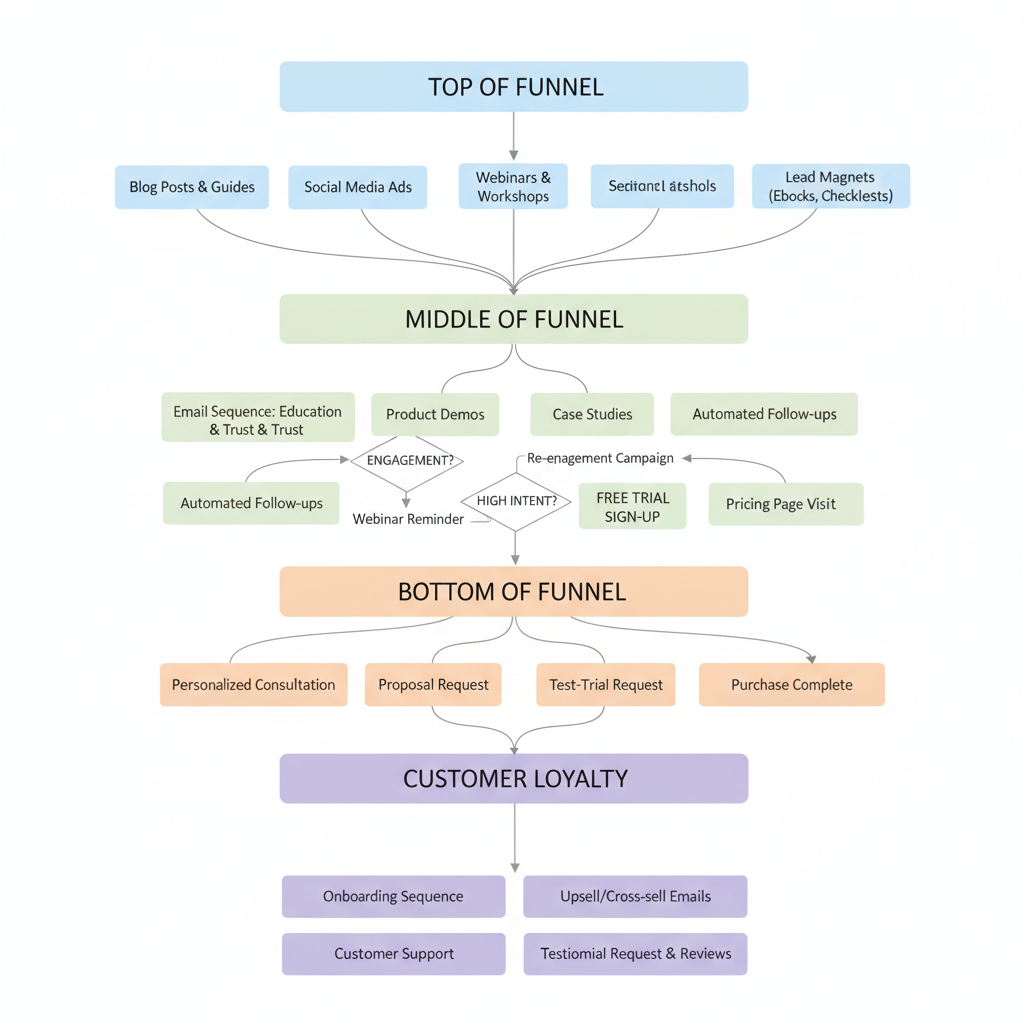
Key Asset Types: Educational blog posts, search engine optimized (SEO) articles, broad social media campaigns, informative videos, and industry reports.
Core Metrics: Unique website visitors, impressions, click-through rates (CTR), and initial session duration.
Middle of the Funnel (MOFU): Consideration and Evaluation
In the Middle of the Funnel (MOFU), prospects have clearly defined their problem and are actively evaluating alternative solutions. They have transitioned from casual readers to identified leads, often by exchanging their contact information for high-value resources.
Prospect Intent: Comparative and solution-oriented. Buyers are evaluating methodology, reputation, and technical competence.
Key Asset Types: Downloadable whitepapers, comprehensive solution guides, webinars, email newsletter series, and detailed case studies.
Core Metrics: Lead capture rate, email open and click rates, resource downloads, and marketing-qualified lead (MQL) generation.
Bottom of the Funnel (BOFU): Conversion and Decision
The Bottom of the Funnel (BOFU) represents the critical juncture where qualified leads decide whether to select your firm or a competitor. At this point, messaging must pivot from educational material to compelling direct offers and trust-building evidence.
Prospect Intent: High transactional intent. Buyers are comparing specific pricing models, contracts, implementation timelines, and service level guarantees.
Key Asset Types: Free consultations, live software demonstrations, targeted proposals, client testimonials, ROI calculators, and pricing guides.
Core Metrics: Sales-qualified lead (SQL) conversion rate, customer acquisition cost (CAC), deal close rate, and average contract value (ACV).
Post-Funnel: Retention and Advocacy
Acquiring a new client is significantly more expensive than retaining an existing one. High-performing organizations extend their funnel beyond the initial transaction to focus on customer satisfaction, repeat business, and client referrals.
Prospect Intent: Value realization and ongoing support.
Key Asset Types: Structured onboarding sequences, exclusive client newsletters, cross-selling campaigns, and referral incentives.
Core Metrics: Customer lifetime value (LTV), retention rate, net promoter score (NPS), and churn rate.
"A systematic marketing funnel converts fragmented marketing initiatives into a reliable revenue engine, enabling businesses to engage prospective clients with precision throughout every phase of their evaluation process."
How Do You Build an Effective Marketing Funnel for a Small Business?
Building an effective funnel requires a methodical approach grounded in audience research, strategic content development, technical infrastructure, and rigorous performance tracking.
Step 1: Define Target Audience Personas and Buyer Intent
Before deploying marketing campaigns, define your ideal customer profile (ICP). For small businesses and local firms operating in competitive markets such as Houston, buyer personas must account for regional nuances, decision-making structures, and specific operational challenges.
- 1 Identify demographic and firmographic traits (industry, company size, revenue, role).
- 2 Document core pain points, operational bottlenecks, and financial goals.
- 3 Analyze search intent using keyword research tools to determine exact search queries used across each buying stage.
Step 2: Map High-Value Content to Each Funnel Stage
Once personas are established, map tailored content assets to address the specific questions prospects ask at each phase.
Top of Funnel Content: Publish authoritative articles addressing broad industry challenges (e.g., "How Commercial Real Estate Trends Impact Houston Small Businesses").
Middle of Funnel Content: Create comparison assets and downloadable resources (e.g., "A Checklist for Selecting an Enterprise Accounting Firm").
Bottom of Funnel Content: Deliver high-trust proof points (e.g., "Case Study: How Local Manufacturing Firm Increased Operating Margins by 22%").
Step 3: Implement Tracking, Automation, and Lead Nurturing
A modern funnel relies on digital infrastructure to ensure leads move smoothly between stages without falling through manual gaps.
Customer Relationship Management (CRM): Centralize prospect data and record all interactions across email, phone, and web channels.
Marketing Automation: Establish automated email drip campaigns triggered when a user downloads a resource or visits high-intent pages.
Web Analytics and Retargeting: Utilize tools like Google Analytics 4 (GA4) to track user paths and implement retargeting campaigns to re-engage past site visitors.
Step 4: Measure Conversion Metrics and Optimize Performance
A marketing funnel requires ongoing refinement. Analyze stage-by-stage conversion metrics regularly to isolate operational bottlenecks and optimize asset performance.
📊 Average Conversion Rates by Funnel Stage (Industry Benchmark)
💡 Tip
Local Business Optimization Tip: For businesses serving specific geographic regions like the Greater Houston area, integrating local SEO—such as optimized Google Business Profiles, localized landing pages, and regional customer reviews—substantially increases Top-of-Funnel organic traffic from high-intent local searchers.
Real-World Examples: How Businesses Apply Funnel Marketing
To understand how funnel marketing operates in commercial practice, consider these two industry-specific implementation models.
Example 1: Commercial Professional Services Firm
A regional B2B consulting firm seeks to acquire corporate clients.
TOFU: The firm publishes an in-depth, search-optimized guide titled "Navigating Corporate Tax Strategy Changes." A local business owner discovers the guide via a search query.
MOFU: At the conclusion of the guide, the reader is invited to download an interactive "Tax Risk Self-Assessment Template" in exchange for their name and business email address. The prospect enters an automated email nurturing sequence featuring regulatory updates and video explanations.
BOFU: After opening three consecutive emails, the system triggers a personalized invitation to schedule a complimentary 30-minute strategic review with a senior consultant.
Retention: Upon becoming a client, the firm enrolls the business in a quarterly strategic brief program, resulting in contract renewals and ongoing advisory service expansion.
Example 2: Specialty Retail and E-Commerce Business
A high-end home furnishings retailer combines digital marketing with a brick-and-mortar showroom presence.
TOFU: The company runs targeted local social media campaigns showcasing interior design tips, driving traffic to a blog post on modern living room layouts.
MOFU: Visitors to the blog post are offered a 10% discount on their first order or a free digital design consultation when they sign up for the email VIP list.
BOFU: Subscribers receive dynamic emails displaying products they viewed, alongside verified customer reviews and a limited-time invitation to book an in-person showroom consultation.
Retention: Post-purchase automated emails provide product maintenance guides, followed by seasonal product release announcements and exclusive private sale invitations.
Key Takeaways for Building High-Converting Funnels
Customer-Centric Design: Build every stage around the prospect's decision-making process rather than your internal sales targets.
Clear Value Exchange: Offer genuine expertise and high-value resources in exchange for prospect contact information at the Middle of Funnel stage.
Systematic Nurturing: Utilize automated email workflows and retargeting to maintain consistent engagement with prospects who are not yet ready to purchase immediately.
Data-Driven Optimization: Continually track stage-to-stage conversion rates to identify leaks, refine messaging, and improve overall marketing return on investment (ROI).
