
Quick Answer
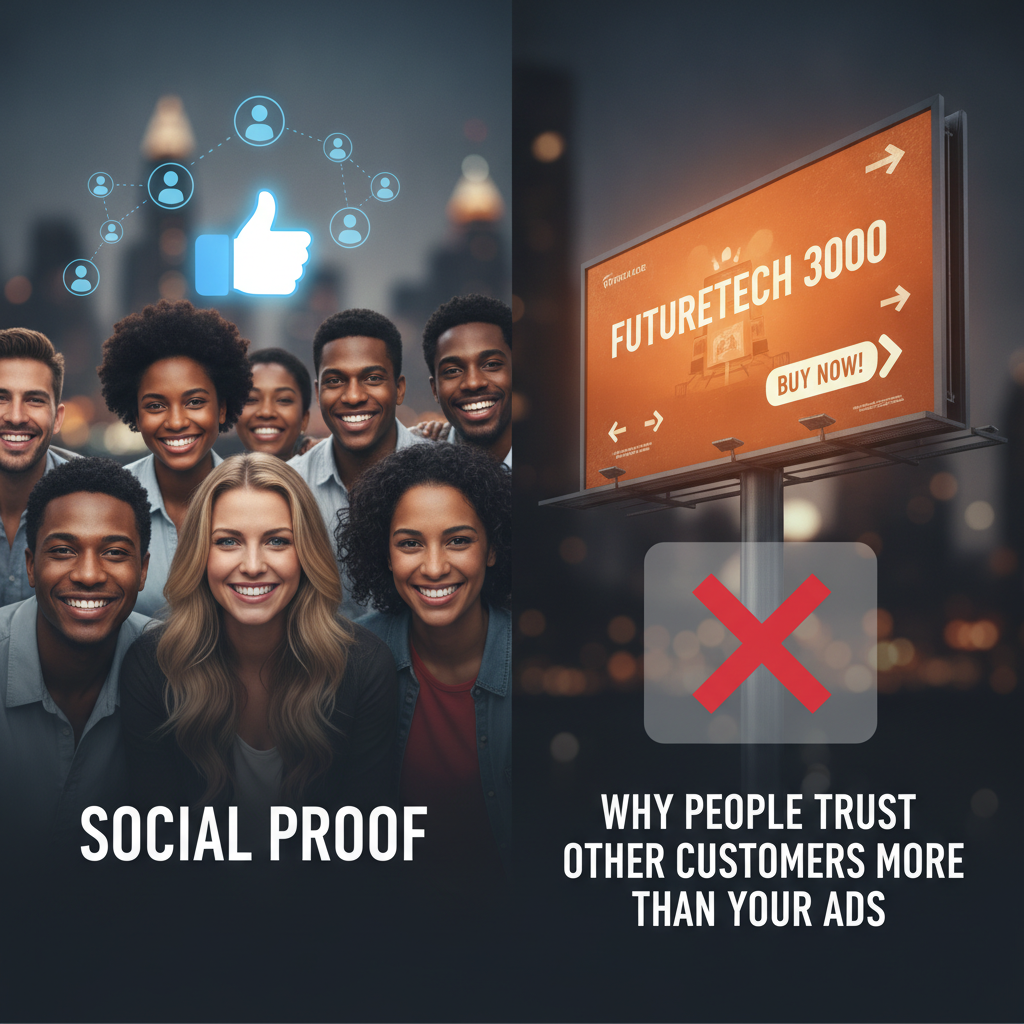
Social proof marketing is a psychological strategy where businesses leverage buyer reviews, user testimonials, and peer recommendations to build trust and drive conversions. Because modern consumers perceive paid advertising with skepticism, authentic social proof acts as validated third-party evidence, dramatically increasing conversion rates and shortening the decision-making lifecycle for potential buyers.
Modern buyers have developed a high degree of ad fatigue. When a company claims its product is revolutionary, consumers naturally suspect exaggeration. However, when an existing customer shares an unscripted, positive experience, potential buyers pay attention.
In digital business, understanding why peer validation outweighs branded messaging is fundamental to building sustainable customer relationships. Integrating intentional social proof strategies across your customer journey transforms hesitant visitors into confident buyers.
What is Social Proof Marketing and Why Does It Outperform Advertising?
Social proof marketing is the practice of highlighting real customer experiences, endorsements, and behavioral data to influence prospect purchasing decisions. It relies on the psychological phenomenon where individuals mirror the actions of others in uncertain situations to determine correct behavior.
In practice, consumers view paid advertisements as inherent self-interest, whereas customer reviews are evaluated as unbiased real-world observations. According to research published in the Journal of Consumer Research, peer-generated feedback provides emotional safety and factual context that traditional brand messaging cannot replicate.
How Does the Psychological Mechanism of Social Proof Work?
Social proof operates primarily through informational social influence. When individuals encounter a new brand or complex product decision, they assume that collective choices reflect superior knowledge.
When a prospective customer sees that thousands of peers have already purchased and enjoyed a product, the perceived risk of a poor decision drops significantly. This psychological shortcut streamlines complex evaluations, allowing buyers to move forward with confidence.
Why Do Buyers Trust Customer Reviews Over Paid Brand Ads?
Buyers trust customer reviews because third-party buyers have no financial incentive to praise a company. Advertisements are designed to highlight ideal scenarios, whereas authentic reviews detail real-world performance, including minor trade-offs.
📊 Trust Level Ratings by Content Source (Nielsen Benchmark)
As demonstrated in trust benchmarks, consumer confidence decreases as brand control increases. Buyers recognize that advertisements present a curated image, whereas user feedback reflects true service reliability and product performance.
What Are the Most Effective Types of Social Proof Strategies?
A balanced social proof marketing strategy incorporates diverse forms of customer validation tailored to different stages of the buying journey. Relying on a single type of feedback limits audience reach, as different buyers respond to distinct signals.
"Authentic customer validation does not eliminate buying friction by making big promises—it removes friction by demonstrating that real people have already realized the promised value."
How Do Customer Testimonials and Case Studies Drive High-Intent Sales?
Testimonial marketing uses detailed, story-based experiences from existing clients to overcome specific buyer objections. In high-consideration sectors such as B2B software, professional services, or premium consumer goods, written and video testimonials provide tangible proof of return on investment.
A common scenario we encounter involves prospects stalling during final negotiations due to risk aversion. Presenting a case study featuring a client in the same industry with identical initial challenges routinely breaks these deadlocks and accelerates deal closures.

What Role Do User-Generated Content and Reviews Play in E-Commerce?
User-generated content (UGC)—including customer photos, unboxing videos, and star ratings—acts as visual validation for retail and direct-to-consumer brands. Seeing a product used in everyday conditions provides practical context that studio photography cannot mirror.
📈 Average Conversion Lift by Social Proof Type
Integrating user reviews directly onto product display pages consistently drives higher engagement and conversion lifts compared to pages relying solely on manufacturer copy.
How Can Industry Certifications and Expert Endorsements Validate Your Brand?
Expert social proof leverages authority to establish immediate credibility. Displaying security badges, regulatory compliance seals, or endorsements from recognized industry authorities reassures buyers about product quality and data safety. This form of validation is particularly critical for financial tools, health services, and emerging technologies.
How to Implement a High-Converting Social Proof Strategy
Building an effective social proof strategy requires systematically gathering authentic feedback and placing it strategically along the buyer journey.
```
Step 1: Capture Feedback ---> Step 2: Curate & Contextualize ---> Step 3: Deploy at Friction Points
(Automated post-purchase) (Tag by buyer persona) (Checkout, landing pages)
```
Step 1: Collect Authentic Feedback at Peak Customer Joy Points
Requesting feedback immediately after a positive interaction yields the highest response rates. Automate review requests after key milestones, such as successful product delivery, completed onboarding, or positive customer support resolutions.
Send personalized follow-up emails within 3 to 7 days of product delivery.
Offer simple, friction-free submission formats (e.g., single-click star ratings or quick video submission links).
Incentivize honest responses without conditioning rewards on positive ratings, preserving feedback integrity.
Step 2: Display Contextual Testimonials Across High-Friction Funnel Pages
Generic praise on a dedicated "Testimonials" page often gets ignored. Instead, embed relevant social proof directly at key decision points across your website.
💡 Tip
Match the content of your social proof to the specific objections common to that page. For example, place security and guarantee testimonials near checkout forms, and feature performance metrics near pricing tables.
Place quotes addressing pricing concerns near pricing tables, and feature shipping or quality assurances directly inside shopping cart drawers to minimize abandonment.
Step 3: Monitor Impact and Refine Social Proof Placement
Track conversion metrics continuously to identify which formats yield the highest engagement. Test different placements—such as dynamic social proof popups, hero-section logos, or detailed quote blocks—to determine what resonates best with your audience.
What Key Metrics and Pitfalls Should You Watch in Testimonial Marketing?
While social proof is highly effective, mismanaging it can harm brand reputation. Consumers are quick to spot unauthentic or overly curated feedback.
"Trust is built in drops and lost in buckets. A single fabricated review can undermine years of genuine customer goodwill."
What Common Pitfalls Undermine Social Proof Credibility?
Fabricated or Overly Polished Reviews: Today's buyers detect scripted praise easily. Minor constructive critiques within reviews actually increase reader trust.
Outdated Validation: Displaying endorsements from several years ago suggests stagnant growth. Keep your proof fresh and continuous.
Vague Quotes: Endorsements like "Great service!" carry minimal weight. Encourage reviewers to mention specific outcomes, features, or saved time.
Key Takeaways for Building Long-Term Trust
Establishing authentic social proof marketing requires consistent effort and genuine customer care. Prioritize transparency over perfection, make feedback collection a routine business process, and place validation strategically where prospective buyers experience hesitation.
Let Authentic Voices Fuel Your Brand's Next Chapter
Building genuine trust in a world filled with constant promotional noise is a deeply human challenge. When you shift the spotlight away from self-promotional claims and invite real customers to share their authentic journeys, buying hesitation softens into genuine connection. True social proof isn't about manipulating decisions—it is about honoring the real experiences of people who have walked in your prospective buyers' shoes.
If you are looking to design a customer validation framework that feels as authentic as the relationships you build every day, we would love to help you capture and highlight those stories. Connect with our team today, and together we can elevate the genuine buyer voices that move your business forward.
