
How Much Should a Small Business Actually Budget for Marketing Each Month?

Quick Answer
A small business marketing budget should typically range between 7% and 12% of gross annual revenue, divided into monthly allocations. Established companies seeking steady growth generally invest 7% to 8%, while newer businesses or those aiming for aggressive expansion often allocate 10% to 15% of total gross revenue toward marketing initiatives.
Determining the right financial commitment for marketing is one of the most critical decisions a small business owner makes. Setting a clear, predictable monthly investment ensures your business maintains a steady stream of leads while protecting your cash flow.
When planned strategically, marketing functions not as an unavoidable overhead expense, but as a reliable engine for long-term business growth.

How Much Should a Small Business Budget for Marketing Each Month?
A standard small business marketing budget generally depends on your total annual revenue, industry standards, and current growth goals. Rather than picking an arbitrary monthly dollar amount, industry benchmarks suggest calculating your budget as a dedicated percentage of gross annual revenue and dividing that figure into twelve predictable monthly budgets.
What Percentage of Revenue Should Go Toward Marketing?
According to guidance from the U.S. Small Business Administration (SBA), small businesses earning under $5 million in annual revenue with net profit margins between 10% and 12% should allocate 7% to 8% of gross revenue to marketing.
However, your specific marketing budget percentage will vary based on your market position and operational model:
B2C Businesses (Business-to-Consumer): Typically invest higher amounts (9% to 12% of revenue) because consumer markets require broader reach and frequent customer engagement across multiple digital channels.
B2B Businesses (Business-to-Business): Generally budget slightly less (5% to 8% of revenue) as sales cycles are longer and target audiences are more targeted.
Early-Stage Startups: Often spend 12% to 20% of expected revenue during their initial launch phase to build brand awareness quickly and acquire their first core audience.
How Does Monthly Marketing Budget Change for New vs. Established Businesses?
New businesses must spend more upfront to generate brand recognition, while established brands can leverage existing customer bases and organic brand equity to maintain customer acquisition momentum.
In practice, an established business generating $500,000 annually might set an 8% overall marketing budget percentage, resulting in $40,000 per year or roughly $3,333 per month. Conversely, a new company aiming to capture market share quickly at the same revenue tier might require a 12% allocation, amounting to $5,000 per month.
📈 Marketing Budget Percentage of Revenue by Growth Goal
How Do You Calculate Your Monthly Marketing Budget?
To calculate an accurate small business marketing budget, follow a systematic method based on total gross revenue and target customer metrics rather than guesswork.
Step 1: Calculate Gross Revenue Projections
Begin by establishing your gross revenue baseline. If your revenue fluctuates seasonally, use the prior 12 months of total revenue or a conservative projection for the upcoming year. Multiply your gross annual revenue by your chosen marketing percentage to determine your yearly marketing capital.
"A consistent marketing budget protects small businesses from the lead starvation cycle—where sales drop because marketing stopped during busy operational periods."
Step 2: Divide into Monthly Operational Allocations
Divide your annual figure by 12 to determine your base monthly spend. This fixed monthly framework prevents overspending during high-revenue months and maintains marketing momentum during slower periods.
Step 3: Factor in Customer Acquisition Cost (CAC)
Validate your monthly spend against your Target Customer Acquisition Cost (CAC) and Customer Lifetime Value (LTV). A healthy business model typically targets a 3:1 ratio, where the lifetime value of a customer is three times higher than the cost to acquire them. If your average CAC is $100 and your monthly budget is $3,000, you should expect to acquire approximately 30 new customers per month from your combined marketing efforts.
💡 Tip
If your business is in its first year, calculating budget strictly as a percentage of past revenue can be challenging due to limited historical data. Instead, establish a realistic baseline dollar amount based on target customer acquisition metrics until predictable cash flow patterns develop.
How Should a Monthly Marketing Budget Be Allocated Across Channels?
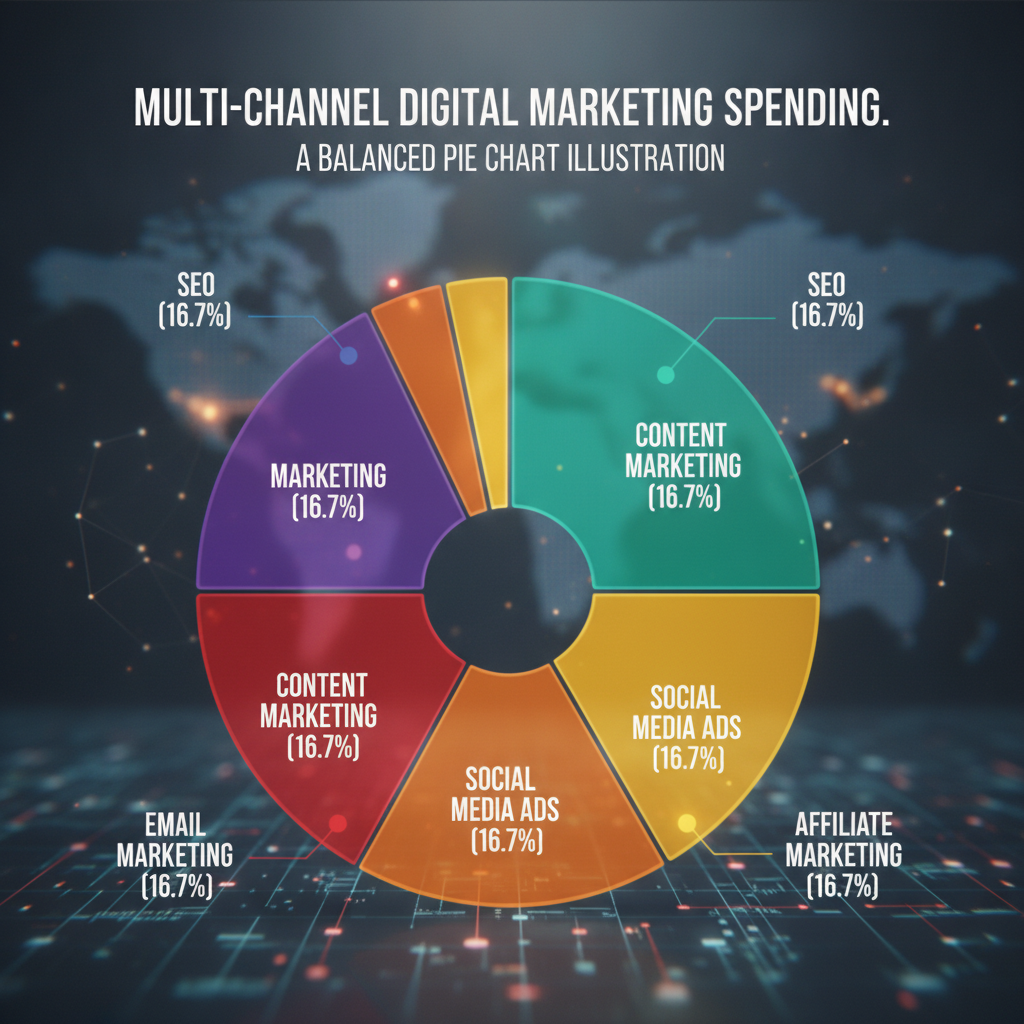
Allocating your monthly marketing funds across balanced channels ensures maximum return on investment without over-relying on a single source of leads. A well-rounded marketing strategy splits capital between direct, short-term lead generation and long-term organic authority building.
Key Digital and Traditional Allocation Categories
A well-balanced small business marketing budget spreads monthly resources across five foundational areas:
- 1 Paid Advertising (30% - 40%): Search engine ads (Google Ads), paid social media campaigns, and targeted local listings that generate immediate leads.
- 2 Content Creation & SEO (20% - 25%): High-quality website content, educational guides, search engine optimization, and video production that build long-term organic reach.
- 3 Website & Infrastructure (15% - 20%): Website hosting, maintenance, security updates, conversion rate optimization, and software tools.
- 4 Social Media & Email Marketing (10% - 15%): Community engagement, customer retention newsletters, and automated email nurturing sequences.
- 5 Events & Community Partnerships (5% - 10%): Local sponsorships, industry trade shows, promotional merchandise, and public relations.
🥧 Recommended Monthly Marketing Channel Allocation
What Are Common Marketing Budget Mistakes to Avoid?
Creating a balanced small business marketing budget is only half the battle; disciplined execution is what drives real business outcomes.
Treating Marketing as an Optional Overhead Expense
A frequent pitfall among growing businesses is treating marketing as a flexible cost to cut whenever short-term revenue dips. Cutting marketing during downturns reduces prospective customer flow right when new revenue is needed most.
"Businesses that maintain or strategically adjust their marketing spending during economic shifts consistently gain market share over competitors who pause their campaigns."
Failing to Track Marketing ROI
Investing money each month without analyzing performance leads to wasted capital. Ensure every dollar spent is connected to clear key performance indicators (KPIs), such as cost-per-lead, conversion rate, and overall return on ad spend (ROAS).
Ignoring Marketing Technology and Baseline Tool Costs
A modern marketing budget must account for baseline software subscriptions, such as customer relationship management (CRM) platforms, email automation software, and analytics platforms. Failing to include these fixed technical costs can result in unexpected monthly expenses that undermine your marketing strategy.
Key Takeaways for Small Business Marketing Budgets
Target Percentage: Aim to invest 7% to 12% of gross annual revenue into your overall marketing efforts, divided into structured monthly allocations.
Business Stage Matters: Startups and aggressive-growth brands should plan for 10% to 15%+ allocation, whereas established businesses can sustain healthy growth at 7% to 8%.
Balance Your Portfolio: Distribute monthly funds between immediate lead generation (paid advertising) and sustainable long-term assets (SEO, content, brand building).
- Maintain Consistency: Keep your monthly spend predictable to prevent operational revenue dips and capture compounding market interest over time.
