

Quick Answer
Growth hacking is a data-driven process that combines rapid experimentation, product design, and analytical marketing to identify the most efficient paths to sustainable business scaling. Unlike traditional marketing focused strictly on top-of-funnel brand awareness, growth hacking analyzes every stage of the user journey to maximize low-cost customer acquisition, active engagement, and retention.
In modern commerce, organizations face rising customer acquisition costs and increasingly saturated digital channels. To build scalable traction, forward-thinking businesses look beyond conventional advertising budgets and embrace agile, experiment-driven strategies. Understanding how to deploy this methodology effectively allows businesses to optimize resources while achieving measurable, repeatable expansion.
What Is Growth Hacking and How Does It Differ From Traditional Marketing?
Growth hacking is an agile strategy focused primarily on rapid growth through low-cost, high-impact channels. Originally coined by Sean Ellis in 2010, the methodology relies on cross-functional alignment between product development, engineering, and digital marketing. While traditional marketing relies on fixed budgets and broad awareness campaigns, growth hacking prioritizes measurable outcomes, iterative testing, and direct product integration to drive scalable adoption.
How Does Growth Hacking Differ From Growth Marketing?
While the terms are often used interchangeably, growth hacking and growth marketing have distinct operational scopes and timelines. Growth hacking focuses on rapid, high-speed experimentation to identify immediate breakthrough opportunities, often using creative technical shortcuts or novel distribution tactics. In contrast, growth marketing is a holistic, long-term discipline that focuses on optimizing the entire customer lifecycle over time using sustainable brand-building strategies.
📈 Funnel Resource Allocation: Growth Hacking vs Traditional Marketing
What Is the AARRR (Pirate Metrics) Framework?
The AARRR framework—developed by entrepreneur Dave McClure—is the foundational metric model used in growth engineering. It categorizes the user journey into five actionable stages:
- 1Acquisition: How users discover the product or service across digital channels.
- 2Activation: The initial point where a user experiences clear value (the "Aha!" moment).
- 3Retention: The frequency with which users return to engage with the product.
- 4Revenue: The process of monetizing active user behavior effectively.
- 5Referral: The mechanism by which satisfied users invite new prospects to join.
By analyzing each stage independently, organizations can isolate friction points and systematically run targeted experiments to improve funnel conversion rates.
What Are the Core Pillars of a Successful Growth Strategy?
A successful growth strategy requires an organizational commitment to continuous testing, deep data analytics, and product-led value delivery. Rather than relying on static marketing plans, high-growth companies build cross-functional teams capable of identifying leverage points within their business model.
How Does Rapid Experimentation Drive Scaling?
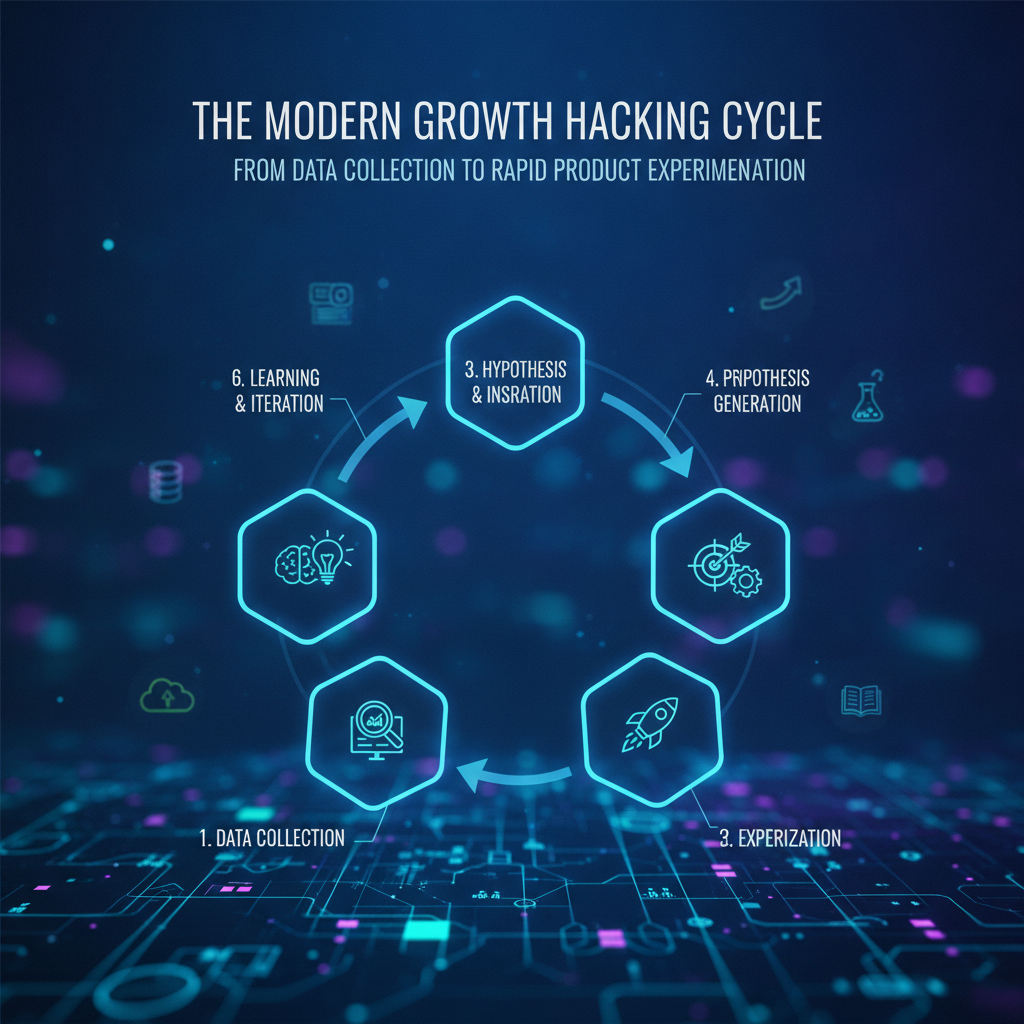
Rapid experimentation involves running hypotheses-driven tests across engineering, product design, and messaging. In practice, teams prioritize tests using the ICE Scoring Model, which evaluates hypotheses based on three metrics:
Impact: How much will this experiment improve our target metric?
Confidence: How certain are we that this experiment will succeed?
Ease: How many resources or technical hours are required to deploy the test?
By scoring potential initiatives on a 1-10 scale, teams focus efforts on high-impact, low-effort opportunities. Based on real-world results across technical sectors, organizations executing 5 to 10 structured tests per week consistently outperform competitors who rely on quarterly campaign reviews.
"True growth hacking isn't about finding a single silver-bullet tactic; it is about building a disciplined, repeatable process of testing and iteration across the entire product ecosystem."
Why Is Product-Market Fit Essential Before Growth Hacking?
Attempting to scale a business without product-market fit inevitably leads to high user churn and wasted capital. Growth tactics can accelerate user acquisition, but they cannot fix an underlying product that fails to solve customer problems. According to benchmarks tracked by industry frameworks like Google Search Central quality guidelines, long-term search authority and user trust stem directly from genuine engagement and low bounce rates, which only occur when product value meets target market demands.
ℹ️ Info
Pro Tip for Business Leaders: Before scaling acquisition budgets, verify your product-market fit using Sean Ellis's 40% Rule. Survey your active user base: if at least 40% of respondents state they would be "very disappointed" if your product disappeared tomorrow, your business is ready to execute aggressive growth marketing tactics.

What Growth Hacking Techniques Yield Proven Results?
Modern growth techniques rely on systematic execution across multiple touchpoints rather than unpredictable luck. By integrating marketing triggers directly into user workflows, companies construct self-reinforcing acquisition engines.
How Does Viral Marketing Build Organic Momentum?
Viral marketing relies on built-in product mechanics that incentivize existing users to invite new users to a platform. This phenomenon is quantified using the Viral Coefficient (K-factor), calculated as:
$$\text{K-Factor} = \text{Average Invites Sent per User} \times \text{Conversion Rate of Invites}$$
When the K-factor exceeds 1.0, the product achieves exponential organic growth. Famous real-world implementations include referral loops (such as two-sided storage incentives) and embedded network signatures on outgoing communications.
🥧 Primary Customer Acquisition Vectors in Product-Led Growth (2024 Benchmarks)
How Does Conversion Rate Optimization (CRO) Accelerate Revenue?
Conversion Rate Optimization involves systematic micro-testing on existing traffic paths to increase the percentage of visitors who complete desired actions. Effective CRO techniques include:
Reducing form field requirements during signup flows.
Introducing dynamic social proof markers near checkout triggers.
Implementing micro-copy changes that clarify customer value propositions immediately upon page load.
Small improvements across sequential funnel steps compound into substantial overall revenue gains. For instance, achieving a 5% improvement across three sequential checkout stages yields a cumulative conversion increase of over 15%.
What Are the Most Common Pitfalls to Avoid?
Despite its proven benefits, misinterpreting growth principles can harm brand health and operational stability. Businesses looking to implement growth engineering should safeguard against several critical missteps.
Why Do Vanity Metrics Harm Long-Term Stability?
Tracking high-level numbers like raw website hits or social impressions without measuring engagement leads to misinformed strategic decisions. Focus instead on actionable retention metrics, such as 30-day active retention rates, customer lifetime value (LTV), and pay-back period on customer acquisition costs (CAC).
What Are the Risks of Relying on "Dark Patterns"?
Using manipulative design choices—known as dark patterns—to artificially inflate short-term metrics ultimately destroys consumer trust. While aggressive pop-ups or hidden cancellation procedures may boost initial conversion rates, they cause long-term harm to brand reputation, elevate customer service overhead, and lead to high churn rates. Caring, sustainable businesses build growth strategies around genuine user value and transparent customer experiences.
Key Takeaways for Business Leaders
To build a scalable and sustainable growth framework, focus on these core execution principles:
Prioritize Product Value First: Establish clear product-market fit before pouring resources into acquisition campaigns.
Adopt the AARRR Funnel: Measure and optimize every touchpoint, paying special attention to activation and retention metrics.
Build an Experimentation Engine: Utilize structured scoring models like ICE to prioritize high-leverage hypotheses weekly.
Integrate Product and Marketing: Embed viral mechanics directly into product user journeys to drive organic customer acquisition.
- Focus on Retaining Customers: Sustainable revenue expansion relies on long-term retention rather than quick top-of-funnel wins.
Navigating Your Unique Path to Sustainable Scale
Scaling a business is deeply personal work. Behind every analytics dashboard, funnel diagram, and conversion metric are real human beings—your team working tirelessly to build something meaningful, and the customers trusting you to solve their real-world needs. Growth hacking isn't about pushing vanity numbers up a chart; it is about uncovering the most genuine, empathetic connections between what you create and the people who need it most.
Whether you are refining your initial product-market fit or looking to unlock hidden leverage points in an established user journey, you do not have to figure it out in isolation. Explore our strategic growth resources, reach out for a collaborative consultation, or start testing your next meaningful hypothesis today. Together, we can build a resilient growth engine designed for sustained success.
