
Quick Answer
Customer Acquisition Cost (CAC) quantifies the total expenditure required to gain a new customer, encompassing all sales and marketing efforts. In contrast, Customer Lifetime Value (LTV) estimates the total revenue a business can reasonably expect from a single customer throughout their entire relationship. The LTV:CAC ratio is a fundamental business growth indicator, revealing the profitability of marketing investments by comparing the value a customer brings against the cost to acquire them.
Understanding the effectiveness of your marketing and sales efforts is paramount for sustainable business growth. While individual campaign metrics offer valuable insights, a holistic view is often needed to truly gauge long-term profitability and strategic success. This is where the powerful relationship between Customer Acquisition Cost (CAC) and Customer Lifetime Value (LTV) comes into play. By carefully analyzing this crucial ratio, businesses can make informed decisions, optimize spending, and build a resilient foundation for the future.
What is Customer Acquisition Cost (CAC)?
Customer Acquisition Cost (CAC) is a key metric that represents the total cost associated with convincing a prospective customer to buy a product or service. It's not just about advertising; it encompasses all expenses related to sales and marketing efforts.
How is CAC Calculated?
Calculating CAC involves summing up all costs spent on acquiring customers over a specific period and dividing that by the number of new customers acquired during the same period. For example, if over a quarter, a business spent $50,000 on sales and marketing efforts and acquired 100 new customers, its CAC would be $500 ($50,000 / 100).
Costs to consider in your CAC calculation include:
Advertising spend (paid ads, social media campaigns)
Marketing salaries and commissions
Sales team salaries and commissions
Software and tools for marketing and sales (CRM, analytics platforms)
Content creation expenses (blog posts, videos)
Overhead related to sales and marketing departments
"Reducing customer acquisition costs by just 10% can significantly improve profitability, often more than a 10% increase in revenue, making CAC optimization a critical focus for businesses."
Why is Understanding CAC Important?
Knowing your CAC helps you understand the efficiency of your sales and marketing strategies. A high CAC might indicate inefficiencies in your campaigns, poor targeting, or a product that isn't resonating with the market. Conversely, a low CAC suggests effective, streamlined acquisition processes. In practice, businesses often find that segmenting CAC by channel (e.g., organic, paid social, direct sales) provides deeper insights into where capital is best invested.
🥧 Components of Customer Acquisition Cost (Est.)
What is Customer Lifetime Value (LTV)?
Customer Lifetime Value (LTV) is a prediction of the total revenue a customer will generate for your business over the entire course of their relationship. This metric moves beyond a single transaction, focusing on the long-term profitability of each customer.
How is LTV Calculated?
Calculating LTV can vary in complexity, but a common, simplified approach involves multiplying the average purchase value by the average purchase frequency, and then by the average customer lifespan.
For instance, if an average customer spends $50 per purchase, buys 3 times a year, and remains a customer for 5 years, their LTV would be $750 ($50 x 3 purchases/year x 5 years). More sophisticated models might also account for gross margin, churn rate, and discount rates.
Key components for LTV calculation include:
Average Purchase Value: The average amount a customer spends per transaction.
Average Purchase Frequency: How often a customer buys from you in a given period.
Average Customer Lifespan: The duration a customer typically remains active.
Gross Margin: The profit margin on the products or services sold.
Why is Understanding LTV Essential?
Understanding LTV shifts focus from short-term gains to long-term relationships, encouraging strategies that foster loyalty and repeat business. It helps businesses identify their most valuable customer segments and tailor marketing efforts to attract more like them. By valuing long-term customer relationships, businesses can prioritize customer retention and satisfaction, which are often more cost-effective than constant acquisition.
Why is the LTV:CAC Ratio So Critical for Business Growth?
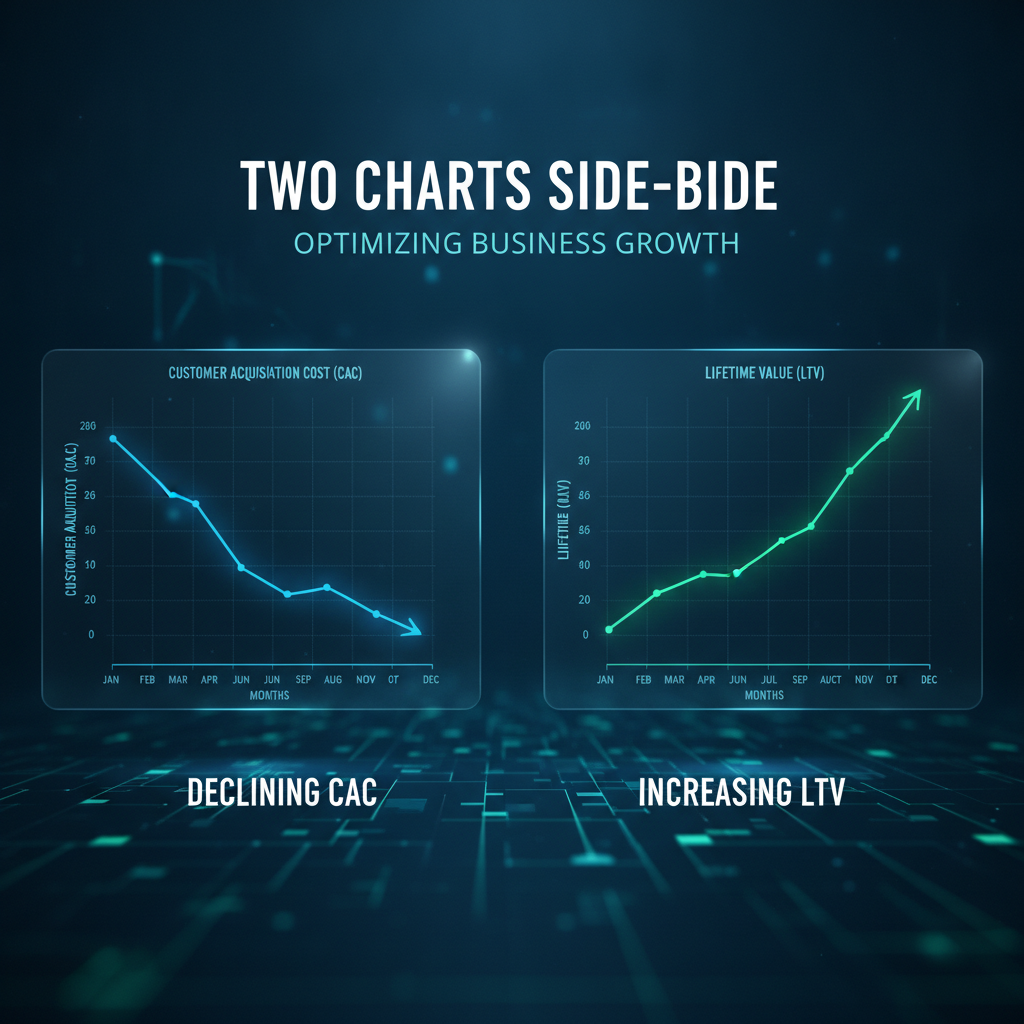
The LTV:CAC ratio directly compares the value a customer brings to your business against the cost of acquiring that customer. This ratio is arguably the most important metric for evaluating the health and sustainability of your business model, acting as a direct indicator of marketing performance.
What Does the LTV:CAC Ratio Reveal?
The LTV:CAC ratio provides a clear picture of profitability per customer. A healthy ratio indicates that for every dollar spent acquiring a customer, the business is generating multiple dollars in return over that customer's lifespan. This suggests that marketing and sales investments are paying off, leading to sustainable growth. A low ratio, conversely, signals that you might be spending too much to acquire customers relative to the revenue they generate, potentially leading to financial instability.
Industry Benchmarks and What They Mean
While optimal LTV:CAC ratios can vary significantly by industry, a commonly cited benchmark for sustainable growth is a ratio of at least 3:1.
1:1 or less: This is a red flag, indicating you are spending as much or more to acquire a customer than they will ever generate in revenue. This model is unsustainable.
2:1: You're covering your costs and making a small profit, but there's significant room for improvement.
3:1: Generally considered a healthy ratio, suggesting a robust business model where customer value significantly outweighs acquisition costs.
4:1 or higher: An excellent ratio, indicating highly efficient marketing and sales efforts, and potentially untapped growth opportunities. However, too high a ratio might suggest you're under-investing in acquisition and could grow faster by increasing marketing spend.
How to Calculate and Interpret Your LTV:CAC Ratio
Calculating and interpreting your LTV:CAC ratio is straightforward once you have your individual CAC and LTV figures.
Step-by-Step Calculation
- 1 Calculate Your CAC: Sum all sales and marketing expenses over a defined period and divide by the number of new customers acquired in that period.
- 2 Calculate Your LTV: Determine the average revenue per customer over their lifespan.
- 3 Divide LTV by CAC: The resulting number is your LTV:CAC ratio.
For example, if your LTV is $750 and your CAC is $150, your LTV:CAC ratio is 5:1 ($750 / $150).
Interpreting Your Ratio for Actionable Insights
Interpreting the ratio goes beyond just the number; it requires understanding the context of your industry, business model, and growth objectives.
💡 Tip
Accurate Data is Key: Ensure your CAC and LTV calculations use consistent timeframes and comprehensive data. Inaccurate inputs lead to misleading ratios and poor strategic decisions. Regularly review and update your calculations as market conditions and business strategies evolve.
A low ratio might prompt a review of your marketing channels for efficiency, or an investigation into customer retention strategies. A high ratio might encourage you to invest more aggressively in marketing to capture a larger market share, as you know those investments are likely to yield strong returns. In a common scenario we encounter, a business with a 2:1 ratio might focus on improving customer experience and loyalty programs to boost LTV, while a business with a 5:1 ratio could explore new, slightly more expensive acquisition channels, knowing the lifetime value will support the increased CAC.
📉 LTV:CAC Ratio Trend 2022-2025
Strategies to Improve Your LTV:CAC Ratio
Improving your LTV:CAC ratio is a continuous process that involves optimizing both customer acquisition and customer retention efforts. It's about finding the sweet spot where you acquire valuable customers efficiently and keep them engaged for longer.
Optimizing Customer Acquisition (Lowering CAC)
Refine Targeting: Focus your marketing efforts on audiences most likely to convert and become long-term customers. Use detailed buyer personas and demographic data.
Improve Conversion Rates: Optimize your website, landing pages, and sales funnels to make the purchasing process smoother and more intuitive. A/B test elements to find what resonates best.
Enhance Organic Channels: Invest in SEO, content marketing, and social media to attract customers at a lower cost than paid advertising. This builds long-term, compounding value.
Automate Processes: Leverage marketing and sales automation tools to reduce manual labor costs and increase efficiency in customer outreach and nurturing.
Boosting Customer Lifetime Value (Increasing LTV)
Improve Customer Satisfaction: A happy customer is a loyal customer. Invest in excellent customer service, responsive support, and consistent quality in your products or services.
Implement Loyalty Programs: Reward repeat purchases and engagement to encourage customers to stay with your brand.
Upsell and Cross-sell Effectively: Offer complementary products or services to existing customers that genuinely add value, increasing their average purchase value.
Enhance Product Value: Continuously innovate and improve your offerings to ensure they remain relevant and valuable to your customer base over time.
- Personalize Experiences: Tailor communications, product recommendations, and offers based on customer behavior and preferences.
Key Takeaways
The LTV:CAC ratio is an indispensable tool for every business owner, marketer, and strategist. It provides a clear, quantitative measure of your business's marketing performance and long-term viability. By consistently monitoring and actively working to improve this ratio, you are making strategic investments in sustainable growth, ensuring that your efforts to acquire customers are not just successful, but genuinely profitable. A healthy LTV:CAC ratio is the hallmark of a resilient business poised for success.
Navigating Your Growth Engine with Confidence and Clarity
Balancing customer acquisition costs with lifetime value isn't just an accounting exercise—it reflects the real human relationships driving your brand forward. Every company’s growth journey brings unique market shifts, evolving customer expectations, and strategic budget decisions. If you are seeking to gain deeper clarity on your marketing ROI, optimize your acquisition channels, or nurture long-term client retention, dedicated support can illuminate the clearest path forward. Reach out to our team today for a tailored performance analysis and build a roadmap engineered for sustainable, profitable growth.
