

Quick Answer
A content audit is a systematic evaluation of all published assets on a website to assess their performance, SEO health, accuracy, and strategic value. Businesses should perform a content audit during site redesigns, after major search algorithm updates, or annually to identify low-performing pages for content pruning and optimization.
What Is a Content Audit and How Does It Work?
A content audit is a comprehensive inventory and analysis of all the pages, articles, landing pages, and digital assets hosted on your website. Rather than relying on guesswork to determine which blog posts or sales pages generate value, an audit provides concrete data on traffic volume, search rankings, backlink profiles, and reader engagement.
By analyzing these metrics, website managers can make informed decisions about which pages to keep, update, merge, or delete.
What is the primary purpose of auditing website content?
The main objective of auditing website content is to align existing pages with current business goals and audience expectations. Over time, digital publications accumulate outdated product listings, thin posts, and overlapping topics that confuse both human visitors and search engine crawlers.
In practice, evaluating metrics such as bounce rate, organic sessions, and conversion rates allows marketing teams to organize pages into four actionable buckets:
Keep: High-performing pages that deliver consistent traffic and conversions.
Update: Pages with strong potential that require refreshed statistics, new media, or improved keyword targeting.
Consolidate: Multiple thin or overlapping posts combined into a single, comprehensive guide.
Prune: Outdated, duplicate, or irrelevant pages removed to improve overall site quality.
A standard evaluation typically reveals that a small percentage of pages drives the majority of site performance, highlighting clear opportunities for optimization.
🥧 Typical Website Content Audit Action Breakdown
How does content pruning fit into the audit process?
Content pruning is the strategic removal or de-indexing of low-value, obsolete, or underperforming pages identified during an audit. Far from hurting search visibility, eliminating low-quality pages helps search engine crawlers process your site more efficiently.
According to guidelines from Google Search Central, optimizing crawl budget ensures search engine bots prioritize your most valuable landing pages rather than indexing legacy archives or low-quality content.
"Pruning low-performing content isn't about deleting site history; it's about signaling to search engines and visitors that every active page on your site provides distinct value."

When Should You Actually Do a Content Audit?
Businesses should conduct a content audit whenever undergoing major structural changes, experiencing unexplained traffic shifts, or after accumulating a significant library of published content.
What are the key triggers for initiating an audit?
While regular reviews are beneficial, specific operational milestones require an immediate, comprehensive content audit:
Website Redesigns or CMS Migrations: Before changing web hosts, domain structures, or site platforms, auditing content helps preserve valuable URLs, map out 301 redirects, and prevent broken links.
Core Search Engine Algorithm Updates: If an update impacts organic rankings, an audit helps identify which page types or topic clusters lost visibility so you can adjust your strategy.
Rebranding or Positioning Shifts: When business models evolve, legacy content must be systematically updated to reflect current branding, pricing, and messaging.
Topic Cannibalization Risks: Websites publishing multiple articles per week often create competing pages for identical search terms, diluting search authority across multiple URLs.
How often should high-traffic websites evaluate their content?
Most active websites benefit from a full content audit at least once per year. However, high-volume blogs and e-commerce websites often conduct light, rolling quarterly audits focused on their top revenue-generating pages.
Establishing a routine review schedule ensures thin or obsolete pages are addressed before they impact domain authority.
💡 Tip
Audit Scheduling Tip: Don't wait for traffic to drop before auditing. Set up a bi-annual review for your top 20% highest-converting pages to keep information accurate and search rankings stable.
What Tools and Metrics Are Best for Auditing Content?
Evaluating hundreds or thousands of URLs manually is inefficient. Modern audit workflows rely on software to collect data points across search performance, user engagement, and technical site health.
How do content audit tools streamline data collection?
Dedicated content audit tools automate site crawls to surface technical errors, broken links, thin word counts, and missing metadata across thousands of URLs simultaneously.
For example, using the Semrush content audit tool allows web managers to automatically audit site subfolders, group URLs by performance criteria, and connect analytics platforms to view Google Analytics and Search Console data in a unified dashboard. Combining crawler data with analytics metrics provides a complete picture of content health.
Which metrics matter most for evaluation?
To assess page quality effectively, track metrics across three distinct categories:
- 1 SEO Metrics: Organic traffic, keyword rankings, incoming backlinks, and crawl status.
- 2 Engagement Metrics: Average time on page, bounce rate, scroll depth, and internal link clicks.
- 3 Business Metrics: Conversion rate, form submissions, and direct revenue contribution.
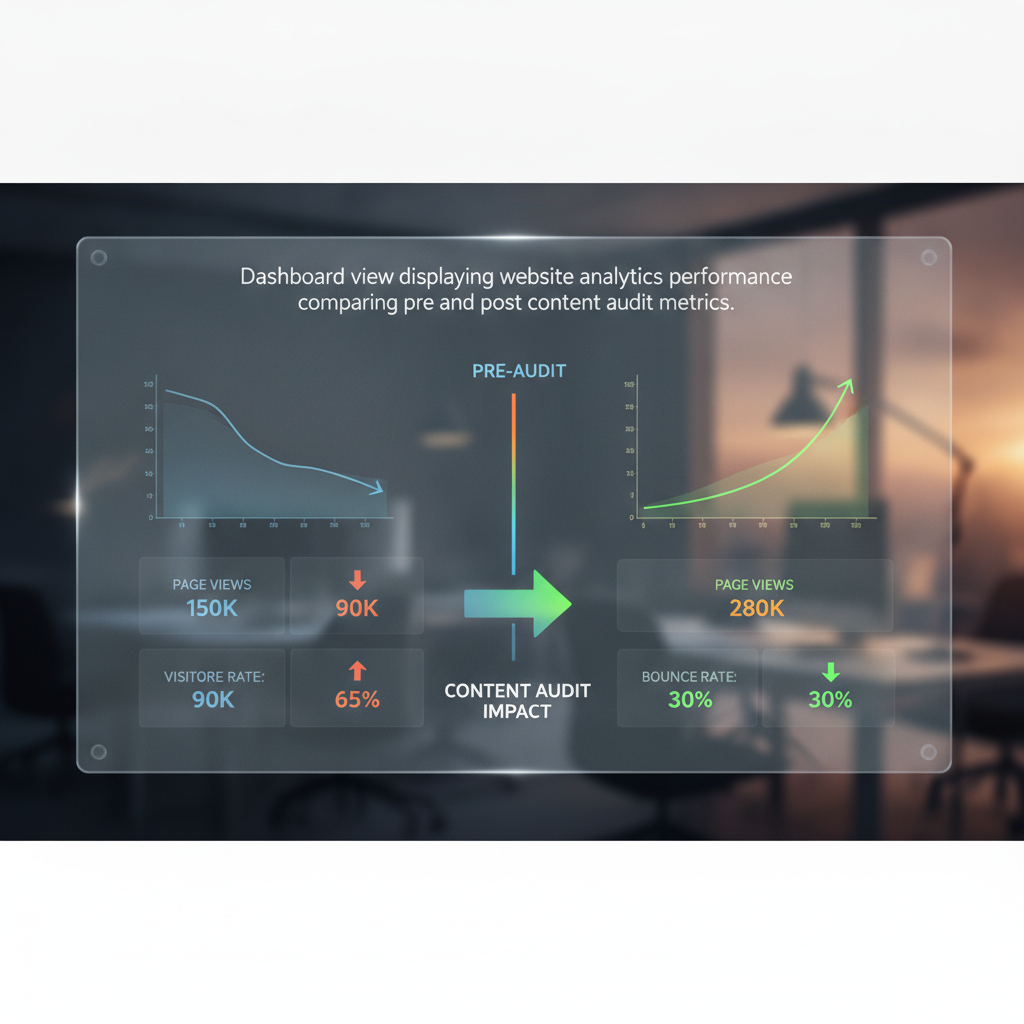
📉 Organic Traffic Impact Post-Audit & Pruning (2022-2025)
How Do You Execute a Step-by-Step Content Audit?
Executing an audit requires a clear workflow to turn raw site data into actionable improvements.
What is the step-by-step audit workflow?
- 1 Establish Clear Goals: Define your primary focus, such as improving organic SEO performance, boosting conversion rates, or updating out-of-date product details.
- 2 Crawl Your Site Inventory: Use specialized audit tools to generate a spreadsheet listing all live URLs, page titles, and canonical headers.
- 3 Integrate Analytics Data: Pair your URL inventory with performance data covering page views, bounce rates, and conversions over the past 6–12 months.
- 4 Evaluate and Categorize Content: Review each page and assign an action status: Keep, Update, Consolidate, or Prune.
- 5 Create an Action Plan: Prioritize high-impact pages first, scheduling rewrites for valuable topics and setting up 301 redirects for pruned URLs.
- 6 Monitor Post-Audit Performance: Track rankings and user engagement over the following two quarters to evaluate improvements.
"Documenting underperforming pages is only the first step. An audit delivers real value when you systematically rewrite, consolidate, or prune those assets."
Summary & Key Takeaways
A regular content audit keeps your website lean, relevant, and aligned with search engine expectations. By identifying low-performing assets and conducting routine content pruning, businesses can improve crawl efficiency and focus authority on their highest-value pages.
Strategic Alignment: Audits help ensure every page serves a defined purpose, whether driving organic search traffic or converting leads.
Optimal Timing: Plan an audit annually, or immediately ahead of site redesigns, platform migrations, and brand positioning changes.
Tool-Assisted Efficiency: Leveraging automated content audit tools streamlines data collection and surfaces actionable performance metrics quickly.
Execution Focus: Focus effort on implementing updates, consolidating overlapping topics, and removing dead weight to drive ongoing performance gains.
Breathing New Life Into the Content You’ve Already Built
Managing a growing website can easily feel overwhelming, especially as older articles fade into the background while your team works hard to publish what's next. You do not have to throw away years of hard work or constantly produce new material to experience meaningful digital growth. By taking a thoughtful, compassionate look at your existing content inventory, you honor the time and effort already invested in your site while making room for modern search standards. Cleaning up digital clutter unburdens your readers, refreshes your search presence, and restores clarity to your team's ongoing publishing goals.
