
Quick Answer
Effective brand storytelling builds emotional resonance and consumer trust by converting abstract features into relatable human experiences. While facts inform buyers, narratives engage the human brain's decision-making centers to drive long-term loyalty and action. Developing an authentic brand narrative transforms traditional communication into impactful thought leadership content that consistently outperforms purely transactional messaging.
Why is brand storytelling more effective than presenting features and facts?
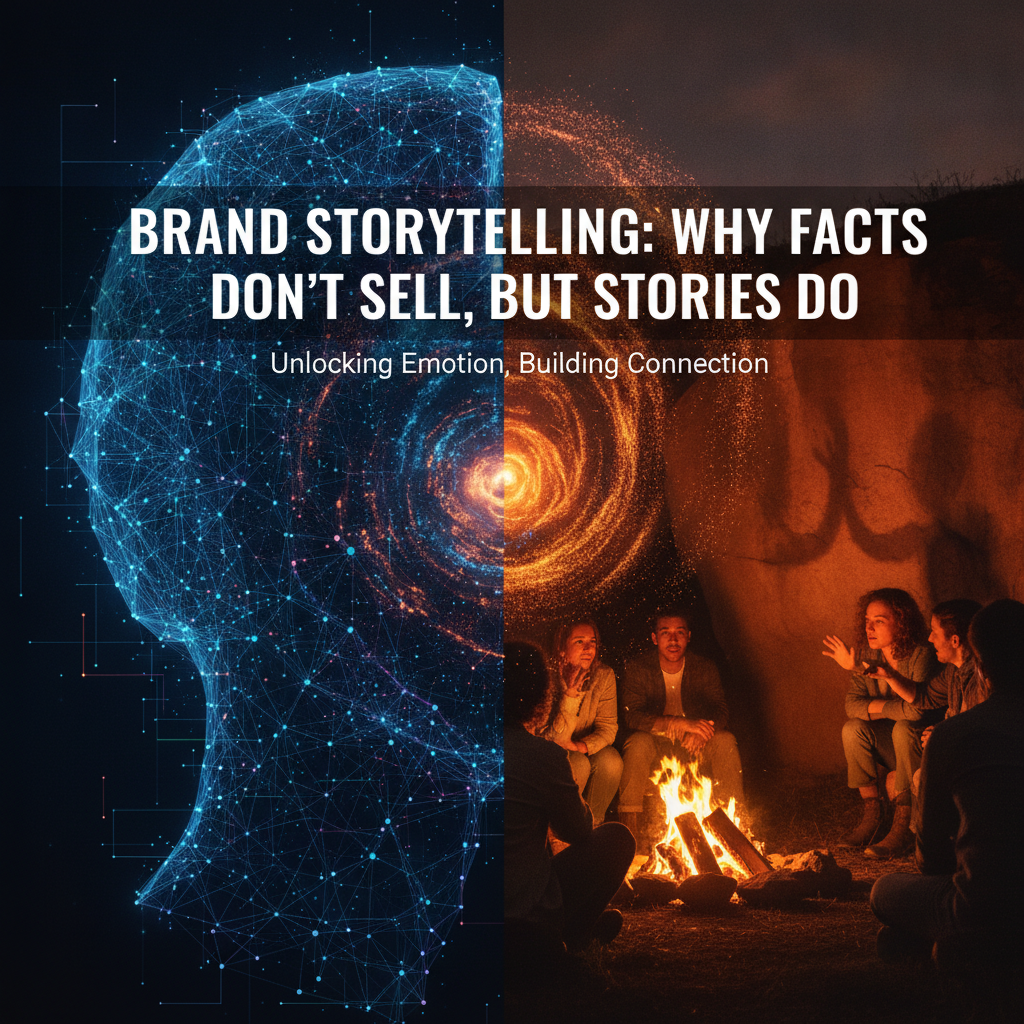
Brand storytelling is significantly more effective than listing features because human decision-making is rooted in emotion rather than pure logic. When audiences encounter raw data or product specifications, only the language-processing centers of the brain (Broca's and Wernicke's areas) activate to decode meaning. However, when information is structured as a story, the brain experiences "neural coupling," activating sensory, motor, and emotional cortices as if the listener were experiencing the events firsthand.
In practice, presenting bullet points of features invites critical analysis and price sensitivity. Conversely, narrative structure releases oxytocin—the neurochemical responsible for empathy and connection—which lowers skepticism and builds genuine rapport.
The Neurological Connection Between Narratives and Purchasing Decisions
Narratives alter how the brain stores and retrieves information. According to cognitive psychology research, individuals are up to 22 times more likely to remember a fact when it is wrapped in a story than when presented as an isolated metric.
When a brand shares a relatable challenge and resolution, the listener's brain synchronizes with the narrative structure. This process, known as Narrative Transport Theory, temporarily suspends disbelief, allowing the audience to focus on the value being demonstrated rather than searching for reasons to reject the message.
📈 Information Retention Rate by Content Format (Cognitive Research)
How Stories Lower Customer Friction and Resistance
Cold facts force potential clients to calculate risk independently, whereas stories provide a pre-packaged mental model of success. By illustrating how a peer navigated a similar obstacle, your business demonstrates proof of capability without resorting to aggressive sales pitches.
A common scenario we encounter involves companies listing technical capabilities on their website, only to experience high bounce rates. When those same capabilities are framed around a customer's real-world transformation, engagement times increase substantially because prospective buyers instantly see their own goals reflected in the content.
Cognitive research demonstrates that humans process stories 22 times more effectively than cold facts alone. When data is wrapped in a narrative, it moves from temporary processing to long-term memory integration.
How do you build an authentic brand narrative for your business?
Building an authentic brand narrative requires structuring your messaging around your customer's journey rather than your company's achievements. To resonate deeply, your narrative must frame the customer as the protagonist, identify their central obstacle, and position your organization as the trusted partner providing the solution.

Step 1: Define the Core Conflict and Customer Hero
Every compelling story requires a protagonist facing a clear challenge. In business messaging, your customer must always hold the role of the hero. Define their primary pain point not just functionally, but emotionally.
Functional Problem: "Our software pipeline has frequent deployment delays."
Emotional Conflict: "Our engineering team feels burnt out and anxious about meeting launch targets."
By addressing both the functional obstacle and the emotional strain, your brand narrative creates immediate relevance and alignment.
💡 Tip
When drafting your brand narrative, always position your customer as the protagonist facing a challenge, and your business as the expert guide providing the key to resolution. Avoid making your company the hero of the story.
Step 2: Establish the Brand as the Trusted Guide
Once the conflict is clear, introduce your brand as the guide equipped with empathy and authority. Empathy communicates that you understand their specific frustration, while authority demonstrates that you possess the expertise needed to solve it.
Authority is best conveyed through past results, proven frameworks, and transparent philosophies—not through boastful claims. This balanced positioning reassures the customer that their goals are achievable with your support.
Step 3: Align Storytelling with Thought Leadership Content
A strong brand narrative should inform all your external messaging, particularly your thought leadership content. Instead of publishing opinion pieces focused purely on abstract trends, ground your industry commentary in real-world observations and client experiences.
When creating strategic content, use your core narrative as an anchor. Ask: Does this piece help our ideal client navigate their current challenge? Does it reflect our foundational values? This approach ensures consistency across all published materials.
📊 Impact of Brand Narrative Alignment on Buying Behaviors
What are the key elements of high-converting thought leadership content?
High-converting thought leadership content bridges analytical proof with human storytelling to establish industry authority. It goes beyond reporting facts by interpreting those facts through a unique operational perspective, helping buyers make informed strategic decisions.
Balancing Emotional Resonance with Analytical Proof
While stories capture attention and build rapport, business decisions ultimately require logical justification—especially in B2B environments involving multiple stakeholders. Effective thought leadership content satisfies both needs simultaneously by introducing a relatable scenario, sharing empirical data to back up the premise, and concluding with clear key takeaways.
For instance, rather than simply stating that automated workflows save 15 hours per week, illustrate a specific team's struggle with manual data entry, introduce the metric as the turning point, and detail the strategic projects the team accomplished once those hours were recovered.
Integrating Real-World Customer Transformation Stories
Abstract advice rarely inspires action. To elevate your messaging, incorporate structured case studies and observational examples that showcase real transformations.
Focus on detailing three specific components:
- 1 The Baseline Context: The client's initial environment and specific constraints.
- 2 The Pivotal Shift: The strategic shift or methodology introduced to resolve the issue.
- 3 The Measured Outcome: The quantifiable metrics and qualitative improvements resulting from the change.
What common brand storytelling mistakes should businesses avoid?
The most common mistake businesses make in brand storytelling is placing themselves at the center of the story rather than focusing on the client's needs. Additional pitfalls include inconsistent brand messaging across digital platforms and prioritizing creative flair over clear communication.
Over-indexing on Corporate History Instead of Customer Value
Many companies confuse brand narrative with executive histories or company timelines. While your history provides context, customers primarily care about how your experience solves their present problems. Keep background information concise, and quickly pivot to how your background directly benefits the client.
Neglecting Consistency Across Digital Touchpoints
A narrative loses power when it is fragmented. If your website conveys a customer-centric story but your sales collateral or customer service channels revert to cold, feature-heavy specs, buyers experience cognitive dissonance. Ensure your brand narrative guides messaging across marketing, sales enablement, and ongoing client communication.
