
Quick Answer
For a service area business operating without a physical storefront, local SEO relies on defining designated service zones in Google Business Profile while hiding the physical address. Effective service area business seo focuses on localized website landing pages, accurate geo-targeted structured data, and authentic customer reviews across target cities to achieve local pack visibility.
Transitioning a local business model from a brick-and-mortar location to a mobile or on-site operation changes the dynamics of search engine optimization. When customers do not visit your physical shop, search engines adjust how they evaluate your proximity, relevance, and prominence.
Managing a service area business (SAB) requires a specialized approach to local search. Without a public street address anchoring your pin on Google Maps, maintaining visibility across your operational footprint demands clear geographic signals, structured data, and localized content strategies.
What is a Service Area Business in Local SEO?
A service area business is a enterprise that visits or delivers directly to customers at their location rather than welcoming foot traffic to a physical office or retail storefront. Common examples include plumbers, electricians, mobile detailers, home cleaners, and outdoor landscapers.
In local SEO, search engines treat storefronts and service area businesses differently. While brick-and-mortar storefronts rely heavily on their exact physical address to capture proximity-based searches, an SAB must establish local relevance through clear service boundaries and distributed digital signals.
```
[Storefront Model] ---> Fixed Address ---> Proximity calculated from physical building
[SAB Model] ---> Hidden Address ---> Proximity calculated from central point & service zones
```
How does Google define a service area business?
Google defines a service area business as any business that meets customers directly at their locations or offers hybrid services (both storefront visits and home visits). According to Google Business Profile Help, businesses that do not serve customers at their registered address must clear or hide their street address on their profile settings.
For example, a locksmith operating out of a home office must select the service area business setting. Displaying a residential address where customers cannot receive walk-in service violates Google's guidelines and risks profile suspension.
Should you hide your physical address on Google Business Profile?
You must hide your physical address on Google Business Profile if your business location does not have dedicated signage and open operating hours for walk-in customers. Concealing your residential or administrative address ensures compliance with search engine guidelines while keeping your private address off public map listings.
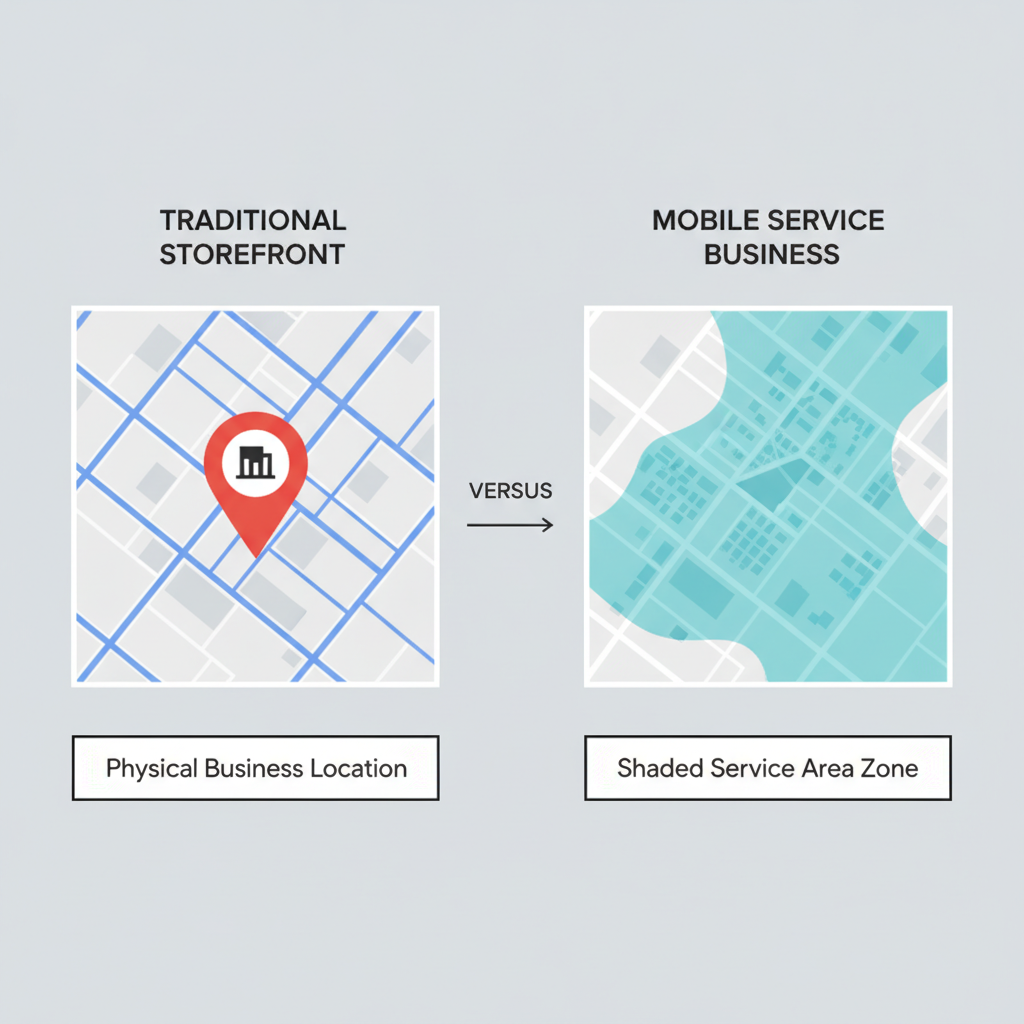
When you hide your address, Google replaces your pinpoint location on Maps with a soft outline representing your overall service territory. Your business continues to appear in local search results and map packs within the specific geographic boundaries you configure.
How Does Google Business Profile Setup Differ for Storefronts vs. SABs?
Setting up a Google Business Profile for a service area business requires specific configurations during creation. Instead of relying on a physical pin drop, search engines calculate your primary territory using specified cities, postal codes, or regional zones.
ℹ️ Info
While storefront businesses benefit from an immediate physical anchor, service area businesses build local authority by demonstrating actual work performed across their entire service perimeter.
What are the specific rules for GMB service area settings?
Google Business Profile allows businesses to specify up to 20 service areas based on cities, counties, or postal codes. To maintain geographic accuracy and search visibility, your overall service perimeter should not extend beyond a 2-hour driving radius from where your business is based.
📊 Key Ranking Factors for Service Area Business SEO
Rather than setting a generic statewide or regional area, select specific municipalities or postal codes where you actively provide services. Granular service area definitions help search algorithms match your business with high-intent localized queries.
How does gmb verification service work when you do not have a storefront?
Completing verification for an SAB involves proving operational legitimacy at your underlying administrative or home address, even though that address remains hidden from the public. When using a gmb verification service or completing self-verification, Google often requires video verification showcasing tools, branded vehicles, equipment, or business registration documents tied to the physical address.
"Authenticity is the foundation of local search trust. Verifying an SAB relies on showing real operational assets, not physical retail counters."
If your location changes or you adjust your business boundaries, re-verification may be triggered. Ensuring your business documentation matches your administrative registration guarantees smooth verification processing.
What Are the Key Service Area Business SEO Strategies That Drive Rankings?
Optimizing a service area business requires shift from relying purely on map proximity to building comprehensive organic signals. Because you lack a physical address pin in every target neighborhood, your website structure and digital footprint must clearly signal local presence.
```
[SAB Website Structure]
│
┌────────────┴────────────┐
▼ ▼
[Core Service Pages] [City Landing Pages]
(e.g., /plumbing) (e.g., /plumbing-austin)
```
How do local landing pages compensate for a hidden address?
Dedicated location landing pages bridge the gap created by a hidden address by providing explicit localized content for every major city or community in your service radius. Rather than creating duplicate content across multiple pages, build rich, unique landing pages that feature:
Specific project highlights or case studies from that specific municipality.
Localized customer testimonials and reviews.
Neighborhood-specific details, local regulations, or regional challenges relevant to your industry.
Clear call-to-actions paired with custom `gmb service` offerings.
📉 Organic Search Traffic Growth Following City Page Optimization (2022-2025)
How do structured data and local citations change for hybrid or non-storefront models?
Structured data (Schema.org markup) helps search crawlers understand your service boundaries programmatically. For an SAB, implement `ServiceArea` or `areaServed` properties within your `LocalBusiness` or `ProfessionalService` schema markup.
```json
{
"@type": "PlumbingService",
"name": "Apex Mobile Plumbing",
"areaServed": [
{
"@type": "City",
"name": "Austin",
"sameAs": "https://en.wikipedia.org/wiki/Austin,_Texas"
},
{
"@type": "City",
"name": "Round Rock"
}
]
}
```
For off-site citations (such as industry directories, Yelp, or YellowPages), maintaining Name, Address, and Phone (NAP) consistency remains essential. Even if directories suppress your physical street address, keeping your core phone number, business name, and listed city identical across all platforms validates your brand's legitimacy.
What Common Mistakes Hurt Service Area Business SEO Performance?
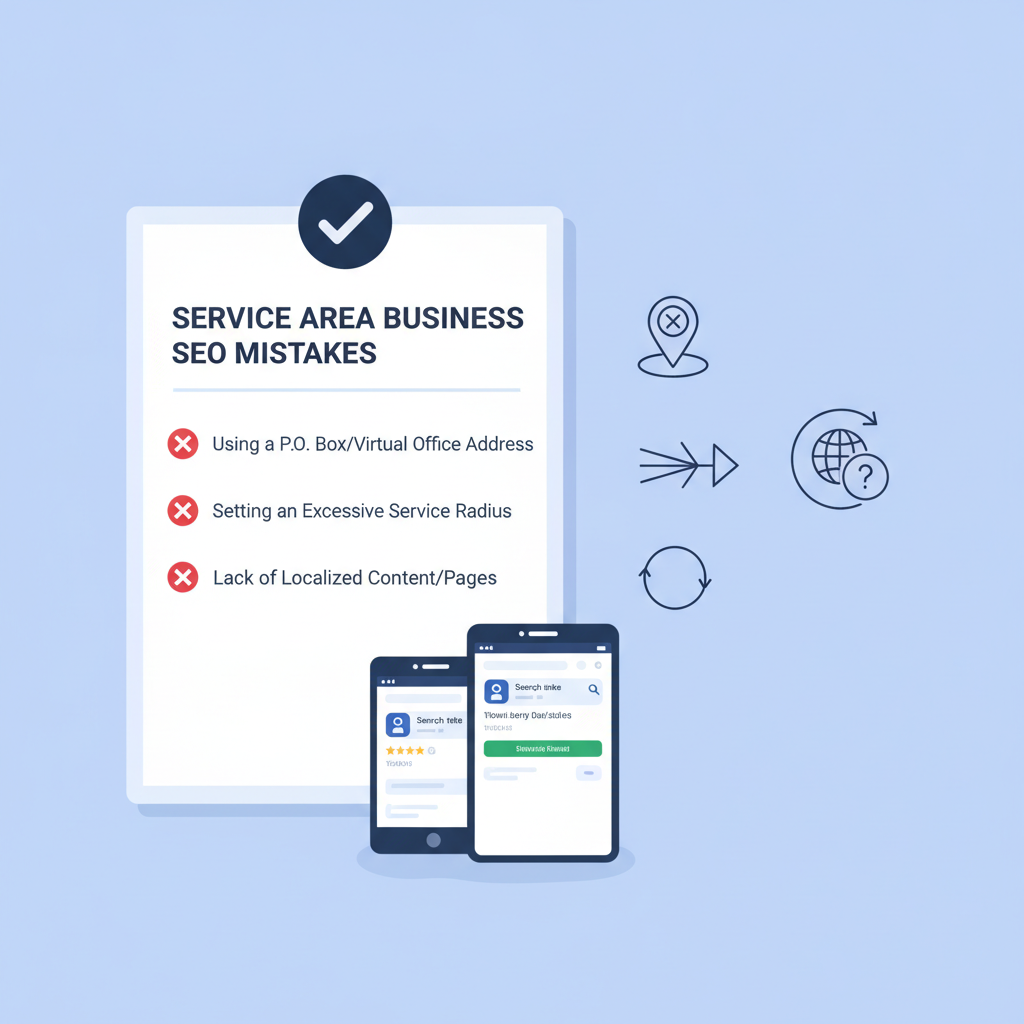
Navigating local search rules without a storefront presents unique compliance challenges. Avoiding common operational and technical errors protects your profile from penalization or reduced map pack visibility.
Why shouldn't you set a service radius larger than 2 hours driving time?
Setting an excessively large service area confuses search algorithms and weakens your core local signals. Google prioritizes businesses that can realistically serve nearby consumers promptly.
⚠️ Warning
Expanding your GBP service radius across an entire state or multiple regions does not expand your ranking area. In fact, setting unrealistically broad boundaries often lowers local search rankings in your primary market.
In practice, search engines favor concentrated geographic relevance. Focusing your service area settings on the immediate regions where your team operates daily yields significantly higher conversion rates and map rankings.
How does listing a PO Box or virtual office affect gmb service eligibility?
Using a PO Box, UPS Store box, or virtual office mail drops as your registered business address violates search engine guidelines. Google's quality standards explicitly state that virtual offices and unstaffed mail locations cannot serve as valid business addresses for verification.
To build sustainable visibility, always register your profile using your legitimate home office or main warehouse address while selecting the option to hide your address from public view. This establishes complete compliance while protecting your personal privacy.
Summary of Core Differences
| Feature | Storefront Business | Service Area Business (SAB) |
| --- | --- | --- |
| Address Visibility | Publicly displayed on Maps | Hidden on public profile |
| Proximity Anchor | Exact street address pin | Central home base / defined zones |
| GBP Configuration | Storefront listing | Service area zones (cities/zips) |
| Landing Page Strategy | Single location focus | Multi-city location pages |
| Schema Markup | `address` property focus | `areaServed` property focus |
