

Quick answer
- Consumer Language Preference: 76% of consumers prefer to purchase from websites in their own language.
- English-Only Barrier: 60% of global shoppers rarely or never buy from English-only websites.
- Declining English Web Share: English usage online dropped 14% between January 2022 and 2025, while Spanish, German, Japanese, and French all increased.
- Revenue Impact: Websites localized in 10 or more languages generate 2.5x more revenue than non-localized sites.
- Market Growth: The language services market is projected to grow from $76.78 billion in 2024 to $104.31 billion by 2029, at a CAGR of 6.32%.
- Future Demand: The global consumer class is projected to reach 5 billion people by 2031, with the majority of growth coming from non-English-speaking markets in Asia and the Global South.
- Best Practices: 9 core tactics cover keyword research, cultural adaptation, hreflang tags, URL structure, duplicate content, search engine targeting, CDNs, and performance monitoring.

Most businesses approach growth by expanding their ad spend or duplicating their existing website into another language. Both approaches tend to underperform. Search engines rank content based on how well it serves a specific audience in a specific location, and an experienced marketing firm knows that a direct translation is rarely ever enough.
This becomes even more important when you consider that the web itself is shifting. English usage online has fallen 14% since 2022, while major non-English languages are growing in parallel.
For any business looking to grow internationally, this shift makes localization not just a best practice but a competitive necessity. Understanding what SEO localization is, how it differs from translation, and which practices actually move the needle is the first step toward building a global presence that sticks.
What’s the Difference Between SEO Localization vs. SEO Translation?
SEO translation converts content from one language to another. It makes content readable to a new audience but stops there. SEO localization goes further by adapting the content to fit local culture, regional idioms, and the specific way audiences in that market search online.
Say you run an online store selling athletic gear in the U.S. and want to expand into Brazil. A translated homepage headline might read "Compre equipamentos esportivos online, frete grátis nos Estados Unidos." The words are correct, but the shipping reference is wrong, and "equipamentos esportivos" is stiff compared to how Brazilian consumers actually talk about sports products.
A localized version would read "Compre seu kit esportivo online, frete grátis para todo o Brasil," using natural, conversational phrasing, the locally preferred term "kit esportivo," and a delivery promise that actually applies to the target market. Same product, same offer, but written for the actual audience.
SEO Translation vs. SEO Localization: A Side-by-Side Comparison
The gap between these two approaches becomes most visible in conversion data. Localized content that respects cultural context sees up to 40% higher engagement than generic translations. For a marketing firm managing multi-market campaigns, that difference in engagement directly affects return on investment.
Why Does SEO Localization Matter?
Expanding into new markets isn’t just about establishing a presence via search engine optimization. It is a matter of establishing something that actually resonates with the target audience. Businesses that invest in SEO localization consistently outperform those that rely on translation alone, capturing more organic traffic, earning stronger regional backlinks, and converting at higher rates.
Is the Language Preference Gap Is Widening?
Consumer preference for native-language content is strong and growing. According to CSA Research (2020), 76% of consumers prefer to buy from sites in their own language, and 60% rarely or never purchase from English-only websites.
According to Lokalise, 88% of companies are either already localizing their products or planning to do so within the next 18 months, reflecting how quickly localization has shifted from a nice-to-have to a standard business practice. The language services market reflects this demand, projected to grow from $76.78 billion in 2024 to $104.31 billion by 2029 at a CAGR of 6.32%.
How Does Localization Impact Organic Traffic and Backlinks?
Localized content surfaces in region-specific search results, expanding the total pool of keywords a site can rank for. It also increases the likelihood of earning backlinks from locally authoritative sites, which strengthens domain credibility in those markets. These signals compound over time and reduce long-term dependence on paid media to reach international audiences.
What Are the Best Practices for SEO Localization?
1. Do Local Keyword Research
How people approach search can vary even within the same language. An Australian audience searching for a contractor might type "builder" while a Canadian audience searches for "general contractor" or "renovation company." Keyword research filtered by country surfaces these differences and uncovers gaps that competitors in that market may already be capitalizing on. Local keywords should be incorporated into body content, meta descriptions, URLs, and image alt text.
2. Adapt to Cultural Differences
Context shapes how audiences perceive and interact with content. A business expanding into Japan, for example, should consider that Japanese consumers tend to respond better to detailed product information and formal language rather than casual, punchy copy. Pricing should reflect local currency, imagery should feature locally relevant people and settings, and any humor or idioms should be reviewed for cultural fit.
WordPress, Shopify, and Magento all offer plugins that support these types of adjustments. A marketing firm working across multiple regions should build cultural adaptation into the localization checklist for every new market.
3. Use Hreflang Attributes
Hreflang attributes are HTML tags that tell search engines which version of a page to serve for a specific country or language. Correct implementation involves:
- Identifying target languages and regions using ISO 639-1 language codes and ISO 3166-1 alpha-2 country codes
- Adding the hreflang attribute to the <head> of each page, covering all alternate versions
- Validating the setup with a site audit tool to identify any errors before they cause indexing issues
4. Avoid Automatic Redirects
Automatic redirects deny users the ability to choose their preferred language version. A Spanish-speaking user in the U.S. redirected to an English-language page has no easy path back. Instead, offer a visible language selector, link to alternate-language versions directly, or use a location-based banner that lets users confirm or change their preference.
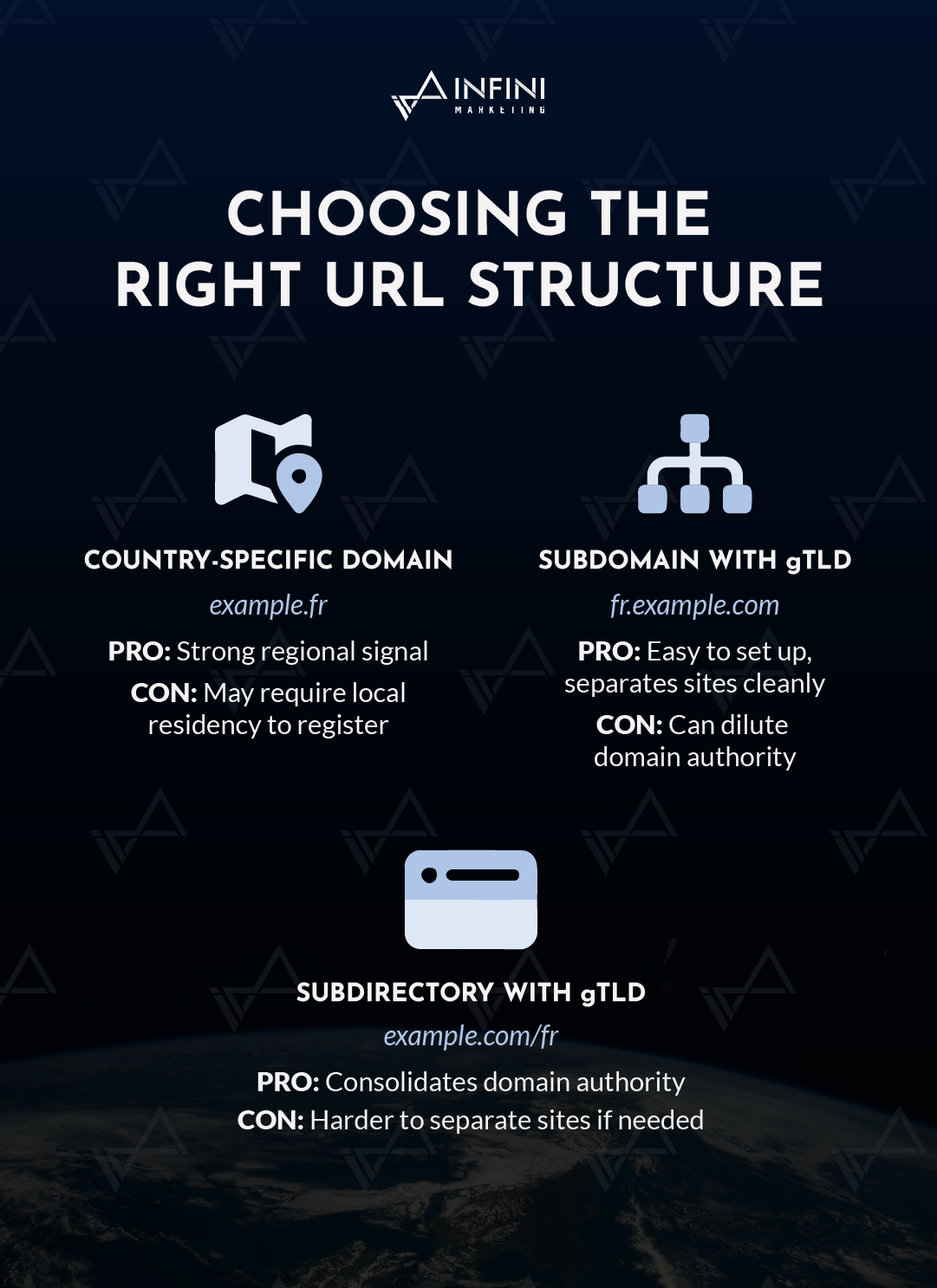
5. Choose the Right URL Structure
Subdirectories are generally the most practical starting point for a marketing firm building out a multi-regional presence, since they consolidate authority under a single domain. Whichever structure is chosen, it must be applied consistently across all localized versions.
6. Address Duplicate Content
Duplicate content across localized pages creates several problems: it confuses search engines about which version to index, dilutes link equity, wastes crawl budget, and can suppress rankings across all versions.
The rel="canonical" tag in the <head> of alternate pages resolves this by pointing search engines to the primary URL. When using both hreflang attributes and canonical tags together, each canonical must reference a page in the same language to avoid conflicting signals.
7. Optimize for Different Search Engines
Google held 79.1% of global desktop search market share as of March 2025, the lowest share recorded in over two decades, but its dominance has not gone unchallenged. Baidu, the leading search engine in China, has difficulty crawling JavaScript and images, so important content should be served in HTML. Yandex, dominant in Russia, weighs user experience signals heavily, making page speed and readability especially important for performance in those markets. Any marketing firm targeting these regions should account for platform-specific requirements rather than applying a Google-only optimization framework.
8. Use Local Servers or CDNs
A content delivery network (CDN) distributes website content across a global network of servers. Visitors receive cached content from the server closest to their location, which reduces load times and improves the experience regardless of where they are. Faster load times are a known search ranking signal, making CDN infrastructure a technical investment with direct SEO implications.
9. Keep an Eye on Your Performance
Localization work does not end at launch. Every time a new language page is added or hreflang tags are updated, the implementation should be validated. Testing the site across different browsers, devices, and geolocations helps catch errors like incorrect currency display, wrong time zone formatting, or broken alternate-language links. SEO localization is iterative; regular audits are what maintain performance as markets and search algorithms evolve.
Conclusion
Global search visibility is more than just translating a webpage. It requires adapting content, structure, and technical setup to the expectations of each target audience in each target market. The data is clear: consumers purchase more when content speaks their language, and the web is becoming less English-dominant every year.
Whether handled in-house or through a dedicated marketing firm, an SEO localization strategy built on these nine practices creates compounding organic growth across international markets.

Sources
- CSA Research. (2020). Can't Read, Won't Buy — B2C. Survey of 8,709 consumers across 29 countries. https://insights.csa-research.com/aim/en/reports/305013241
- Weglot. (2025). Top Multilingual Website Stats and Localization Trends for 2025. https://www.weglot.com/guides/multilingual-website-stats-and-localization-trends
- Mordor Intelligence. (2024). Language Services Market Size and Forecast 2024 to 2029. https://www.mordorintelligence.com/industry-reports/language-services-market/market-size
- StatCounter via Statista. (2025). Market share of leading desktop search engines worldwide, March 2025. https://www.statista.com/statistics/216573/worldwide-market-share-of-search-engines/
- Astute Analytica. (2024). Translation Service Market Size and Share. https://www.astuteanalytica.com/industry-report/translation-service-market
- Brookings Institution. (2023). How the world consumer class will grow from 4 billion to 5 billion people by 2031. https://www.brookings.edu/articles/how-the-world-consumer-class-will-grow-from-4-billion-to-5-billion-people-by-2031/
- W3Techs. (2025). Localization Trends Shaping 2025. https://localizejs.com/articles/localization-trends
