
Is Digital Marketing Legitimate? Data, Evidence, and Real-World Results

Quick answer
- Global Ad Spending: Exceeds $1 trillion annually.
- Digital Share: Over 70% of global ad spending goes to digital channels.
- Email Marketing ROI: Generates $36–$42 for every $1 spent.
- Paid Campaign ROI: Can deliver 200% or greater ROI when effective.
- Future Growth: Global digital ad spending is expected to approach $800 billion in 2025 and surpass $900 billion soon after.

Digital marketing is a highly legitimate, measurable, and economically vital modern industry and not just a speculative trend. With global advertising spending exceeding $1 trillion annually and over 70% dedicated to digital channels, businesses worldwide depend on it for growth and customer acquisition.
This investment is driven by measurable returns, such as email marketing generating $36–$42 for every $1 spent and effective paid campaigns delivering 200% or greater ROI.
The industry's expansion is projected to continue, with global digital ad spending nearing $800 billion in 2025 and eventually surpassing $900 billion.
How Does The Industry Prove Its Legitimacy?
One of the most compelling indicators of legitimacy is the sheer scale of the digital marketing industry. Companies do not allocate billions of dollars to ineffective strategies. Instead, marketing budgets follow performance and measurable results.
Global advertising markets have expanded significantly in the digital era. According to industry forecasts, worldwide advertising spending is expected to surpass $1 trillion, with digital channels accounting for roughly three-quarters of all advertising spending.
Similarly, digital advertising spending alone reached approximately $740 billion in 2024 and is projected to grow to nearly $800 billion in 2025.
This growth reflects a fundamental shift in how businesses reach customers. As consumers increasingly spend time online—whether searching, browsing social media, or streaming content—companies follow the audience by investing in digital channels.
Global Digital Advertising Growth
This level of investment demonstrates that digital marketing is not merely legitimate—it is now the primary engine of global advertising.
Why Should Businesses Trust Digital Marketing?
Businesses invest in digital marketing because it provides something traditional advertising historically struggled to deliver: precise measurement.
Traditional media such as television, radio, and print advertising often rely on estimated audience reach. Digital marketing, by contrast, allows businesses to measure exactly how many people see an advertisement, click it, visit a website, and ultimately become customers.
The following table illustrates the difference.
Traditional vs Digital Marketing Measurement
Because digital marketing campaigns provide detailed analytics—such as cost per click, cost per acquisition, and conversion rate—companies can continuously optimize campaigns to improve results.
This measurable performance is one reason digital channels now account for more than 70% of global advertising spending
How Can Digital Marketing Produce Measurable ROIs?
Another key indicator of legitimacy is return on investment (ROI). Businesses allocate marketing budgets based on expected financial returns.
Research consistently shows that digital marketing channels outperform many traditional marketing strategies.
For example, email marketing has long been considered one of the most profitable marketing channels. Studies show that email campaigns generate an average return of $36 to $42 for every $1 spent, equivalent to an ROI of 3,600% to 4,200%.
Pay-per-click advertising and local service ads also produce strong returns when implemented effectively. Some research indicates that small businesses reallocating a portion of their marketing budgets to digital channels can achieve 200% ROI from pay-per-click advertising alone.
These measurable returns explain why companies continue to increase their digital marketing budgets year after year.
Does Consumer Behavior Confirm the Shift to Digital?
Digital marketing’s growth is also driven by consumer behavior. Modern customers increasingly research products, compare services, and make purchases online.
Advertising data shows that digital formats now account for more than 70% of marketing budgets globally, reflecting the migration of consumer attention toward digital platforms.
This shift has transformed marketing strategies across industries. Businesses now rely on search engines, social media, content marketing, and online advertising to connect with customers during the buying process.
Why Businesses Choose Digital Marketing
The alignment between consumer behavior and marketing investment reinforces the legitimacy of digital marketing as a core business strategy.
Case Study: How Did INFINI Slash Lead Costs For Their Construction Client?
While industry statistics demonstrate the scale and performance of digital marketing, real-world case studies show how these strategies work in practice.
One of Infini’s clients, a mid-sized metal building construction company, experienced dramatic improvements in lead generation through a targeted digital marketing strategy.
The Challenge
Before implementing a structured digital marketing campaign, the company faced several common marketing challenges:
- Limited online visibility
- Inconsistent lead generation
- High cost per lead
- Inefficient advertising spending
These issues are common among businesses that rely heavily on traditional marketing or poorly optimized digital campaigns.
The Strategy
INFINI implemented a multi-channel digital marketing approach that included:
- Search engine optimization (SEO)
- Paid search advertising
- Conversion-focused landing pages
- Data-driven campaign optimization
- Lead tracking and analytics
These tactics allowed the marketing team to identify which channels generated the most valuable leads and adjust spending accordingly.
The Results
Through careful optimization and analytics, our digital marketing agency helped the company improve its marketing efficiency dramatically. The result was a 10× improvement in cost per lead, demonstrating the power of well-executed digital marketing strategies.
This case study illustrates a core advantage of digital marketing: the ability to continuously test, measure, and improve campaigns based on real data.
What Are Common Misconceptions About Digital Marketing?
Despite overwhelming evidence of its effectiveness, some skepticism about digital marketing persists. Much of this skepticism stems from misinformation or misleading claims from unverified sources.
How much should I spend on digital advertising?
Ad budget varies based on your industry, goals, and competition. Start with a test budget to gather data, then scale what works best. Proper allocation ensures you don’t overspend while maximizing ROI. Continuous monitoring helps adjust spending to meet your business objectives effectively.
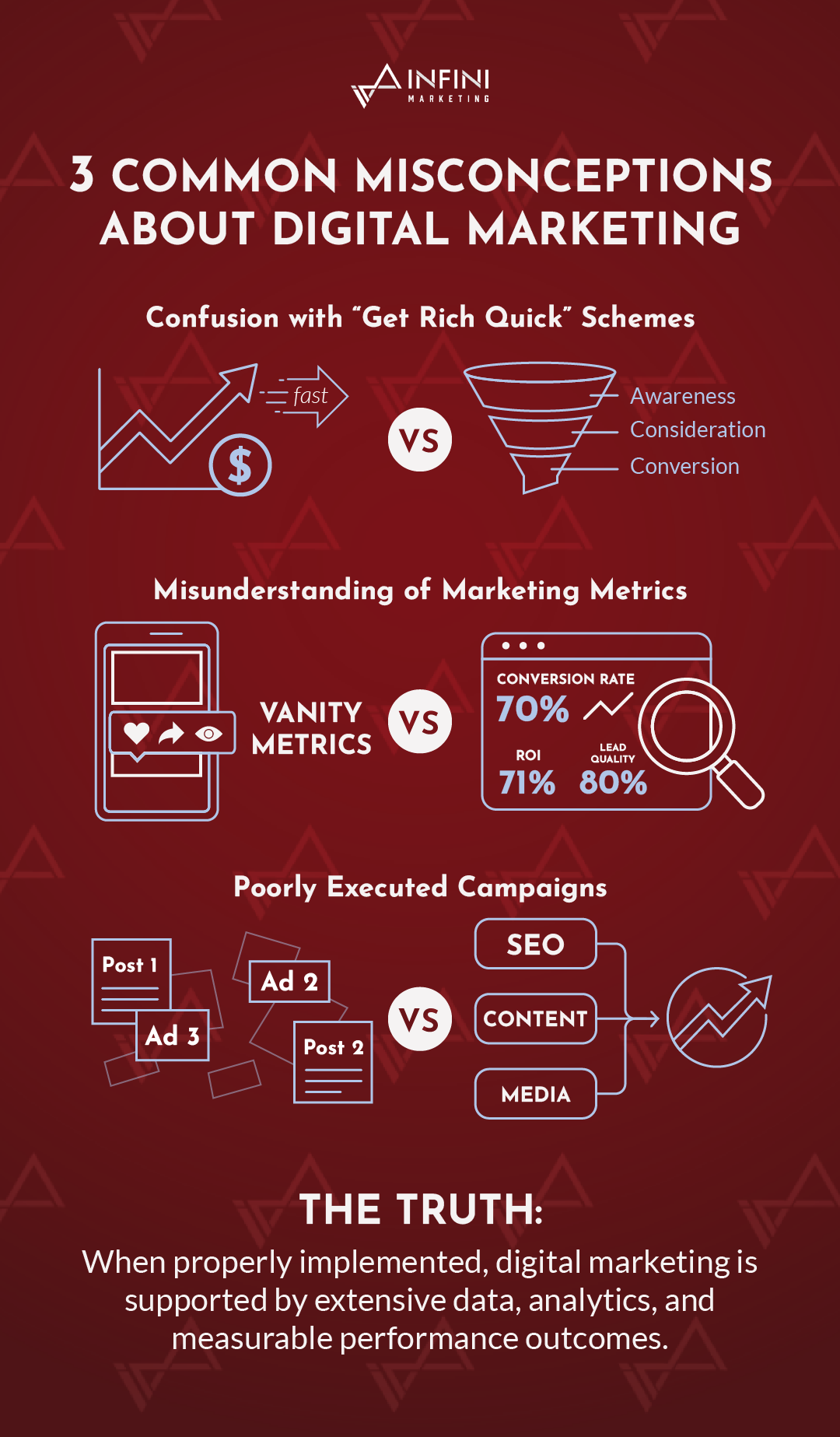
Common misconceptions include:
1. Confusion with “Get Rich Quick” Schemes
Some online programs promote unrealistic expectations about digital marketing income. These programs can create the impression that digital marketing itself is fraudulent.
In reality, digital marketing is simply a set of tools and strategies used by legitimate businesses worldwide.
2. Misunderstanding of Marketing Metrics
Digital marketing relies heavily on analytics and performance data. Without understanding these metrics, it may be difficult for some observers to recognize its impact.
3. Poorly Executed Campaigns
Like any business strategy, digital marketing requires expertise. Ineffective campaigns can lead to poor results, but this does not invalidate the legitimacy of the field itself.
When properly implemented, digital marketing is supported by extensive data, analytics, and measurable performance outcomes.
What Is The Future of Digital Marketing?
Looking ahead, digital marketing is expected to remain the dominant force in global advertising.
Industry forecasts indicate that the digital advertising market will continue to expand steadily, with total digital ad spending projected to approach $1 trillion annually within the next decade.
Several trends are driving this growth:
- Artificial intelligence in advertising optimization
- Personalized marketing strategies
- Growth of social media and video platforms
- Expansion of e-commerce and online marketplaces
These developments suggest that digital marketing will become even more sophisticated and data-driven in the coming years.
Conclusion
The evidence overwhelmingly confirms that digital marketing is a legitimate and highly effective business strategy. The industry commands hundreds of billions of dollars in annual investment, with global advertising spending exceeding $1 trillion and digital channels accounting for over 70% of total advertising budgets.
Businesses continue to increase their investment because digital marketing provides measurable performance, strong ROI, and precise targeting capabilities that traditional advertising cannot match. With channels such as email marketing delivering returns of $36–$42 per dollar spent and paid advertising campaigns generating significant conversion rates, the economic value of digital marketing is well established.

Real-world case studies, such as Infini Marketing’s work with a mid-sized metal building construction company, further demonstrate how data-driven strategies can dramatically improve marketing efficiency—achieving outcomes like a 10× reduction in cost per lead. Taken together, industry statistics, consumer behavior trends, and tangible results all confirm the same conclusion: digital marketing is not only legitimate, but it has become one of the most powerful tools businesses use to grow in the modern economy.
Sources
- Accio. (2025). Ad spend trends 2025: Digital dominance hits $1 trillion. Retrieved from https://www.accio.com/business/ad-spend-trends-2025?
- DataReportal. (2025). Global advertising trends report. Retrieved from https://datareportal.com/reports/digital-2025-sub-section-global-advertising-trends
- Oberlo. (2024). Digital ad spend worldwide statistics. Retrieved from https://www.oberlo.com/statistics/digital-ad-spend
- Precedence Research. (2025). Digital ad spending market forecast. Retrieved from https://www.precedenceresearch.com/digital-ad-spending-market
- SalesHandy. (2026). Email marketing statistics and ROI benchmarks. Retrieved from https://www.saleshandy.com/blog/email-marketing-statistics/
- Digiexe. (2026). Online advertising statistics and ROI data. Retrieved from digiexe.com/blog/online-advertising-statistics/
