

Quick Answers
- Email marketing delivers an average ROI of $36 for every $1 spent
- 27% of marketers cite website, blog, and SEO as their top ROI-driving channel, ranking it #1 ahead of paid social media, email, and all other digital channels
- Companies with an active social media presence see up to 32% more revenue than those without
- Businesses that use marketing analytics are 23% more likely to outperform competitors in customer acquisition
- PPC advertising returns an average of $2 for every $1 spent, with top-performing campaigns doing significantly better
- Most organic strategies take 3–6 months to build measurable traction, but the leads generated cost significantly less over time than paid-only approaches
- Working with a marketing firm can accelerate results, especially when internal resources are limited

Marketing your business online is one of the most cost-effective ways to grow, but only when it's done with intention. With over 5 billion internet users worldwide as of 2024, digital marketing gives businesses of all sizes direct access to their ideal customers at a fraction of traditional advertising costs. Whether you're managing marketing in-house or working with a marketing firm, this guide covers everything you need: understanding your audience, choosing the right channels, building a plan, and measuring results so you can market smarter, not harder.
Why Is It Important to Understand Your Audience?
The most common reason marketing fails is simple: businesses talk to everyone and reach no one. Before investing in ads, social media, or website redesigns, you need to clearly define who your ideal customer is.
Go beyond basic demographics. Think about their daily challenges, their goals, what they search for online, and what they value in a product or service. The more specific your picture of your customer, the more personal and persuasive your marketing becomes. A good marketing firm will always start here, and so should you.
What is a Buyer Persona?
A buyer persona is a fictional but data-informed profile of your ideal customer. Give each one a name, a job, a set of goals, and a list of frustrations. This exercise forces you to write messaging that speaks directly to a real person's needs rather than a vague, general audience.
Most businesses benefit from having two to three distinct personas. Each one may respond to different channels, content types, or offers, and that insight alone can dramatically improve your marketing results.
What is a Brand Message?
Your brand message answers one core question: why should someone choose you over everyone else? A clear, consistent answer to that question, delivered in a voice that feels authentic to your business, builds the kind of trust that converts browsers into buyers.
Whether your tone is friendly, professional, or bold, it should stay consistent across every piece of content you publish, every email you send, and every reply you post online. This is one of the first things any experienced marketing firm will help you establish before running a single campaign.
What Are the Different Online Marketing Channels?
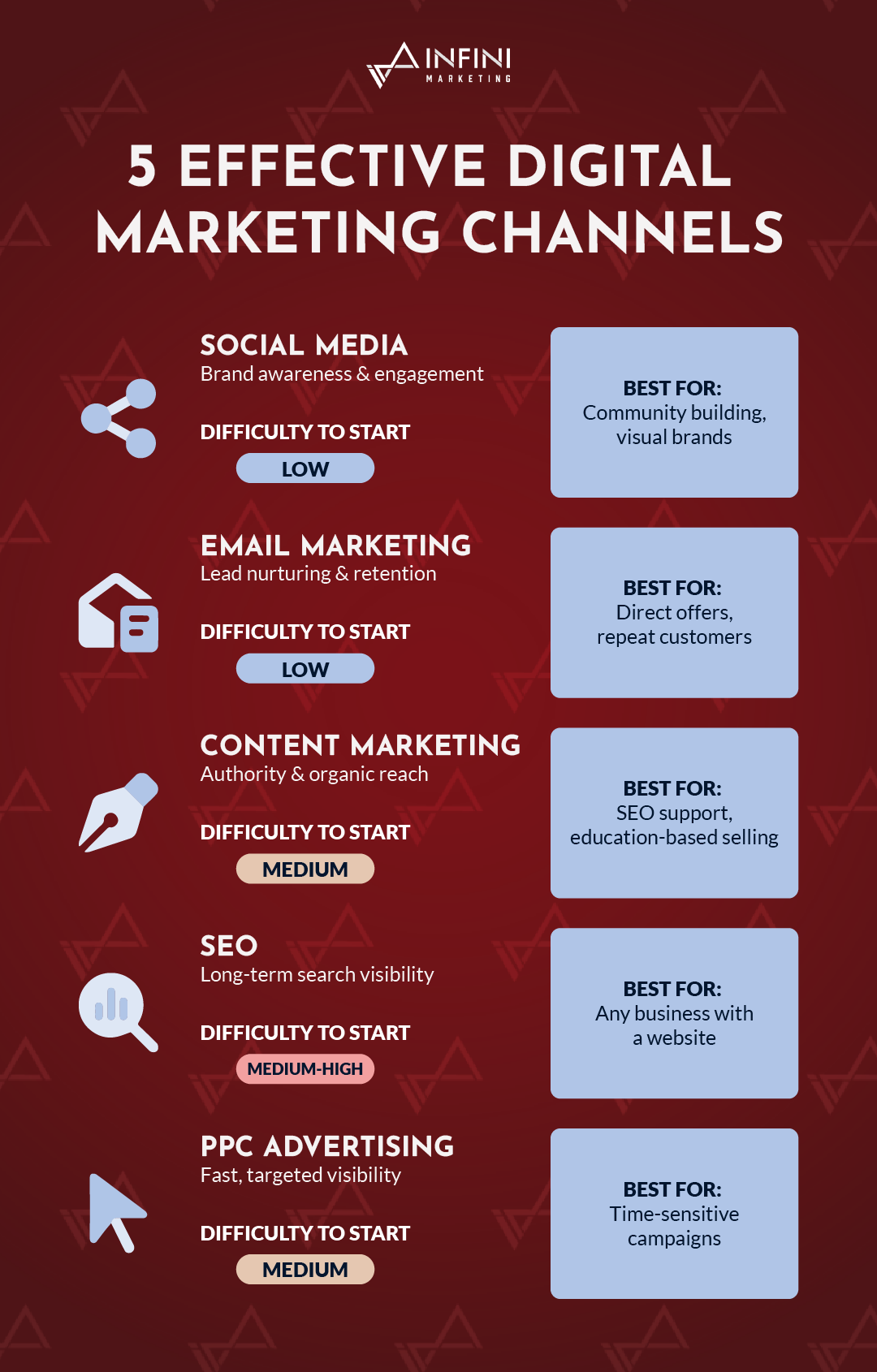
Once your messaging is clear, it's time to choose your channels. The table below summarizes the five most effective digital marketing channels for businesses, along with their primary use case and typical difficulty to start.
Each channel serves a different purpose. Social media builds relationships over time, while PPC can generate visibility almost immediately. Email is ideal for warming up leads and retaining customers, while SEO and content marketing compound in value the longer you invest in them. Many businesses partner with a marketing firm specifically to manage the more technical channels like SEO and PPC, where expertise makes a significant difference in results.
Which Channel Should You Start With?
If you have more time than budget, start with organic channels, particularly social media and content marketing. These take longer to gain traction but cost very little to get going. If you have a budget and a tested message, paid advertising can put your business in front of your ideal audience much faster.
A useful rule: treat your early digital marketing efforts as a series of small experiments. Start with one or two channels, see which ones deliver real engagement or conversions, and let the data guide where you invest more. If you're unsure where to begin, consulting a marketing firm for an initial strategy session can save significant time and wasted spend.
How Do You Build a Marketing Plan That Works?
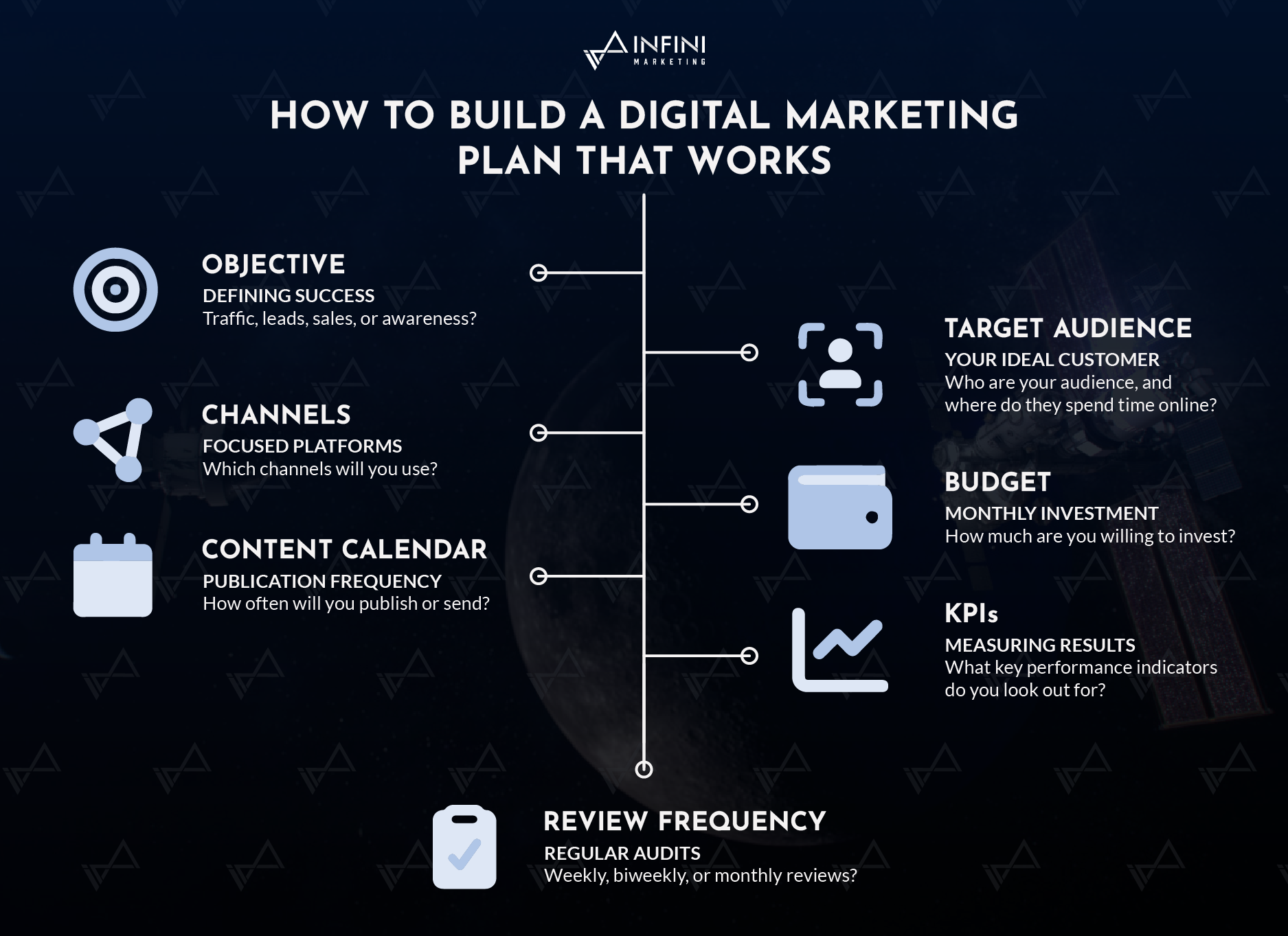
A marketing plan doesn't need to be complex, but it does need to be intentional. The key components of an effective plan are outlined below.
Without this structure, marketing tends to become reactive: posting when you remember, emailing when it's convenient, running ads with no clear goal. A plan keeps your efforts consistent and connected to actual business objectives. If you're working with a marketing firm, this plan becomes the shared roadmap that keeps both sides aligned and accountable.
What Metrics Are Important to Track for Digital Marketing?
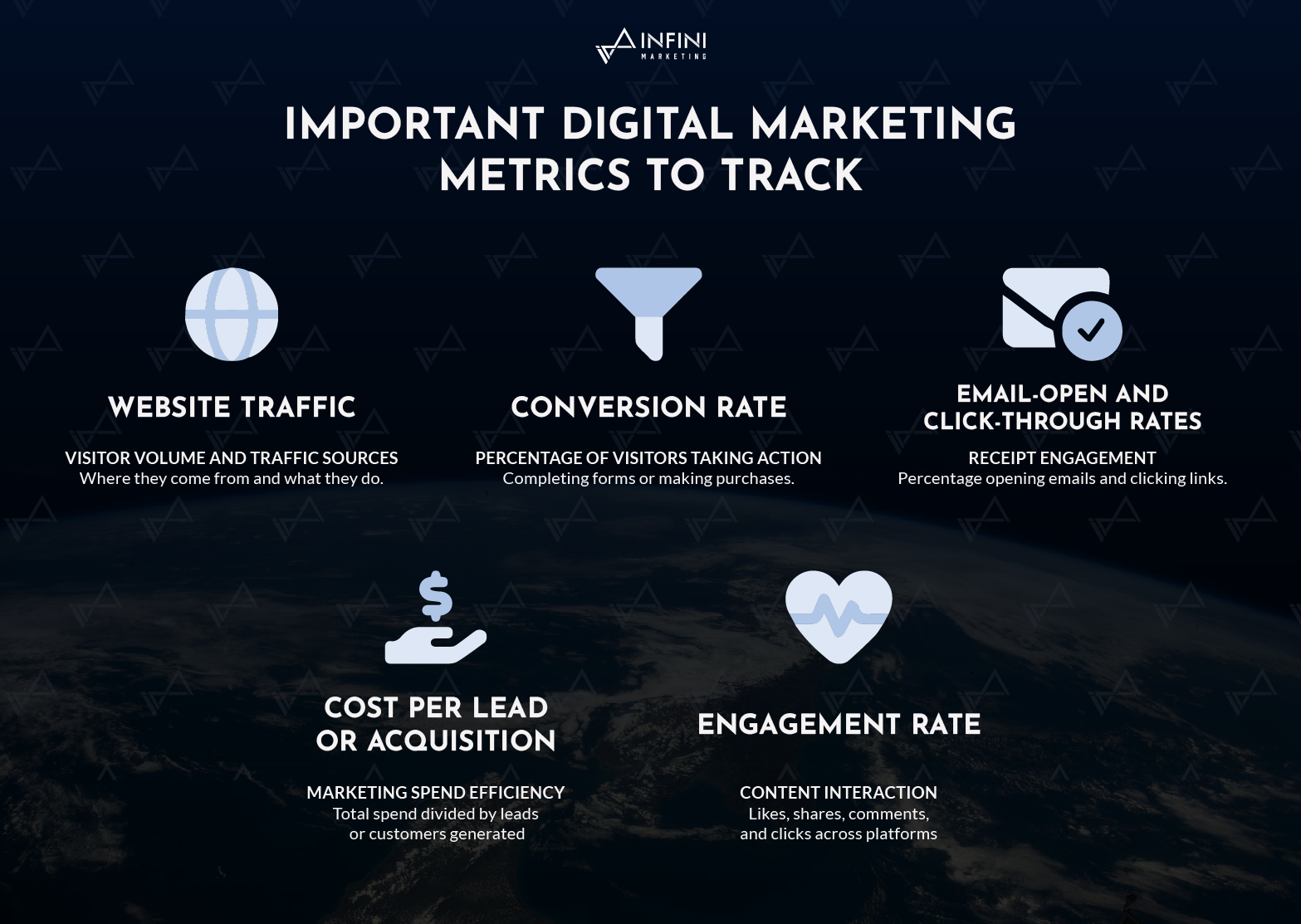
One of the biggest advantages of digital marketing is that almost everything is measurable. Every email you send shows you open rates and click rates. Every page on your website shows you where visitors came from and what they did when they arrived. Every ad tells you how much a conversion cost.
The key metrics to monitor based on your goals are:
- Website Traffic: the number of visitors coming to your site and where they are coming from
- Conversion Rate: the percentage of visitors who complete a desired action, such as filling out a form or making a purchase
- Email Open and Click-Through Rates: the percentage of recipients who open your emails and click on links within them
- Cost Per Lead or Acquisition: the total amount spent divided by the number of leads or customers generated
- Engagement Rate: the level of interaction your content receives, including likes, shares, comments, and clicks
Review these on a regular schedule, monthly at minimum, and make adjustments based on what you find. Marketing is rarely static, and what works in one quarter may need to evolve as your audience and market shift. A dedicated marketing firm will typically handle this reporting layer for you, surfacing the insights that matter most.
What Are the Most Common Digital Marketing Mistakes?
Understanding what not to do is just as valuable as knowing best practices. Here are the most frequent missteps:
- Trying to Be on Every Platform: results in diluted effort and inconsistent messaging
- Skipping Audience Research: campaigns without a defined audience feel generic and get ignored
- Posting Too Infrequently: digital ads need between 5 to 9 exposures before they improve brand recognition and consumer acceptance
- Neglecting Analytics: decisions made without data are just guesses
- Expecting Instant Results: most organic strategies take 3–6 months before significant traction builds
- Copying Competitors: what works for another business may not align with your audience or goals
How Can Infini Marketing Help Your Business?
Industry statistics tell one story. Real results tell another. Here's a look at what happened when one of Infini Marketing's clients, a mid-sized metal building construction company, stopped guessing and started marketing with a strategy built around data.
The Problem
The company was generating leads, but at a cost that made scaling impossible. Their digital presence was inconsistent, their ad spend was spread thin, and there was no clear picture of which efforts were actually working. Sound familiar? These are among the most common challenges Infini Marketing sees when onboarding a new client in a trade or construction-adjacent industry.
Without reliable data, every marketing decision was essentially a guess, and guessing gets expensive fast.
The Infini Marketing Approach
Rather than throwing more budget at the problem, Infini Marketing built a structured, multi-channel strategy designed to find efficiency before scaling. The core components included:
- Search engine optimization (SEO) to improve organic visibility for high-intent search queries
- Paid search advertising targeted at audiences actively looking for metal building solutions
- Conversion-focused landing pages designed to turn clicks into actual inquiries
- Lead tracking and analytics to connect every lead back to its source
- Ongoing campaign optimization based on real performance data, not assumptions
The key shift was moving from activity-based marketing to outcome-based marketing. Instead of measuring impressions and clicks, Infini Marketing focused on cost per qualified lead and adjusted spend accordingly.
The Results
The impact was significant. By identifying which channels produced the most valuable leads and reallocating budget toward those sources, Infini Marketing helped the company achieve a 10x reduction in cost per lead. That means for the same spend, the business was generating ten times the number of leads it had before.
This kind of improvement doesn't happen by accident. It's the result of treating marketing as a measurable system rather than a series of one-off efforts, and it's exactly the approach Infini Marketing brings to every client engagement.
What Does This Mean for Your Business?
This case study reinforces a point Infini Marketing makes with every client: the biggest gains in digital marketing rarely come from spending more. They come from understanding where your current spend is being wasted and fixing that first. Once efficiency is established, scaling becomes straightforward.
Whether you're in construction, professional services, retail, or any other industry, the same principles apply. Infini Marketing helps you define your audience, track your leads, and build a strategy that lets the data tell you where to invest next.
Conclusion
Effective online marketing isn't about having the biggest budget. It's about having the clearest strategy. Know your audience, choose a manageable number of channels, show up consistently, and let data drive your next move. Whether you're managing everything internally or partnering with a marketing firm to handle execution, the fundamentals remain the same: clarity, consistency, and a commitment to continuous learning.

Sources
- Litmus. (2024). The ROI of Email Marketing https://www.litmus.com/blog/infographic-the-roi-of-email-marketing
- HubSpot. (2026). 2026 State of Marketing Report. https://www.hubspot.com/marketing-statistics
- DataReportal. (2024). Digital 2024 Global Overview Report. https://datareportal.com/reports/digital-2024-global-overview-report
- Branding Strategy Insider. (2024). Reach, Frequency, Advertising and Brands. https://brandingstrategyinsider.com/reach-frequency-advertising-and-brands/
