
Quick Answer
Google ads impression share measures the percentage of impressions your ads receive compared to the total number of impressions they were eligible to receive. Monitoring this metric helps advertisers identify lost market coverage due to budget constraints or poor ad rank. Understanding impression share is essential for scaling successful campaigns and preventing ad fatigue across target audiences.
What Is Google Ads Impression Share and Why Does It Matter?
Google Ads impression share is a performance metric that reveals the percentage of potential ad impressions your campaigns capture compared to the total pool of impressions they were eligible to receive. In practice, eligibility is determined by your current campaign targeting settings, approval statuses, bids, and Quality Scores.
When digital marketers evaluate account performance, they frequently focus on surface metrics like click-through rates (CTR) or total conversions. However, impression share provides critical context by showing how much market share you are capturing versus how much you are leaving on the table.
```
Impression Share = (Actual Impressions / Total Eligible Impressions) × 100
```
How Is Impression Share Calculated?
Google calculates impression share by dividing the number of impressions your ad received by the total estimated impressions your ad was eligible to receive. Google estimates eligible impressions using complex auctions throughout the day, taking into account location targeting, device preferences, user search intent, and quality metrics.
If your search campaign has an impression share of 60%, your ads appeared in 6 out of 10 eligible search auctions. The remaining 40% represents lost opportunities where your target audience searched for your keywords, but your ad failed to serve.
🥧 Average Impression Share Distribution (Search Campaigns)
What Are the Key Impression Share Metrics?
To diagnose performance bottlenecks accurately, Google Ads Help divides overall impression share into specific, actionable sub-metrics:
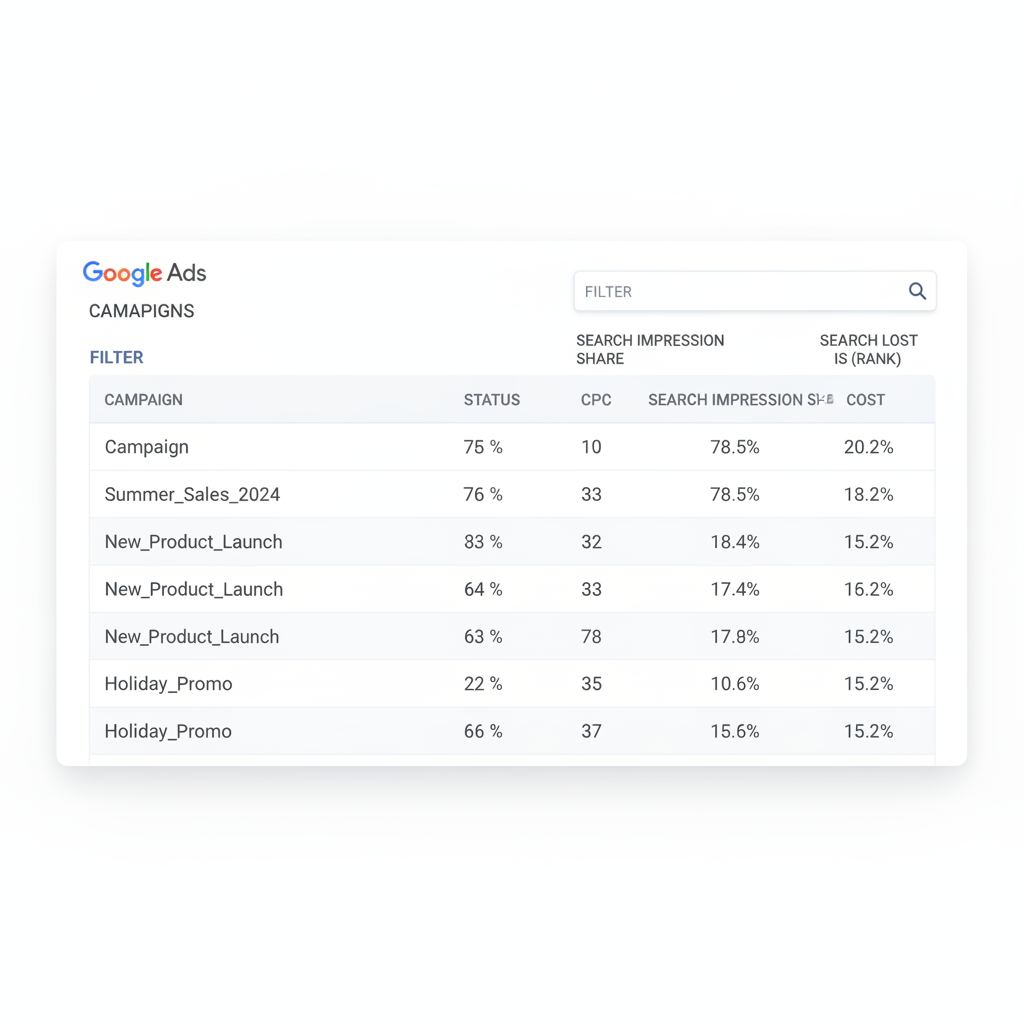
Search Impression Share: The impressions you’ve received on the Search Network divided by the estimated number of impressions you were eligible to receive.
Search Lost IS (Budget): The percentage of time your ads didn't show due to an insufficient daily budget.
Search Lost IS (Rank): The percentage of time your ads didn't show due to poor Ad Rank (determined by bid amount and Quality Score).
Exact Match Impression Share: The percentage of impressions captured for search queries that exactly matched your keywords.
Why Do Most Accounts Overlook Impression Share?
Many business owners and marketing teams overlook impression share because standard reporting dashboards prioritize immediate output metrics such as spend, clicks, and conversions. While these metrics indicate current activity, they fail to reveal growth potential or hidden account inefficiencies.
In a common scenario we encounter, a business owner might celebrate a campaign that generates 50 leads per month at a stable target cost-per-acquisition (CPA). However, if that campaign has a Search Impression Share of only 25% due to budget constraints, the business is effectively ignoring 75% of its reachable market.
"Focusing solely on conversion volume without monitoring impression share is like measuring store traffic without knowing how many customers walked past your front door."
The Misconception of CTR and Conversions Alone
High click-through rates and steady conversion rates can create a false sense of security. An ad group might maintain an impressive 8% CTR, but if its impression share is only 15%, the ad is appearing to a tiny fraction of qualified buyers. Evaluating conversion volume in isolation conceals whether your campaign is dominating its niche or merely scraping the surface.
ℹ️ Info
Pro Tip: Lost Impression Share (Rank) often signals low Quality Scores or suboptimal bidding strategies. Improving ad relevance, asset extensions, and landing page user experience can dramatically increase your market share without requiring a budget increase.
How Impression Share Loss Directly Impacts Revenue
When impression share is lost to budget or rank, competitors naturally step in to capture those missed impressions. Over time, losing market presence reduces brand recall across your target demographic. Furthermore, low impression share restricts the data volume available to automated bidding strategies, making machine learning optimization slower and less precise.
How Can You Improve Your Google Ads Impression Share?
Improving your google ads impression share requires a systematic approach based on whether your lost share stems from budget limitations or rank deficiencies.
How to Fix Lost Impression Share Due to Budget
If your reports show high Search Lost IS (Budget), your campaign budget depletes before the day ends, forcing Google to pause your ads in subsequent auctions.
- 1 Reallocate Spend: Shift budget from lower-performing campaigns to high-converting campaigns experiencing budget loss.
- 2 Adjust Dayparting (Ad Schedule): Restrict ad delivery to peak hours when prospective customers are most likely to convert, preserving budget for high-value windows.
- 3 Refine Location Targeting: Narrow your geographic parameters to high-intent regions rather than spreading your spend too thin across broad territories.
How to Fix Lost Impression Share Due to Rank
If your reports reveal high Search Lost IS (Rank), your ads are being outbid or rated poorly in competitive auctions.
Improve Quality Score: Enhance ad text relevance, align keyword groups tightly, and optimize landing page speed and mobile responsiveness. Adhering to standards such as Google's Search Quality Rater Guidelines ensures your landing pages provide clear, trustworthy value.
Optimize Bid Strategies: If using manual CPC, increase bids on high-performing keywords. If using Smart Bidding, evaluate whether your Target CPA or Target ROAS targets are overly restrictive.
Refine Keyword Match Types: Replace overly broad match keywords with phrase or exact match types to ensure your bids compete only in highly relevant auctions.
📉 Impression Share & Campaign Scale Growth
How Does Impression Share Connect to Ad Fatigue?
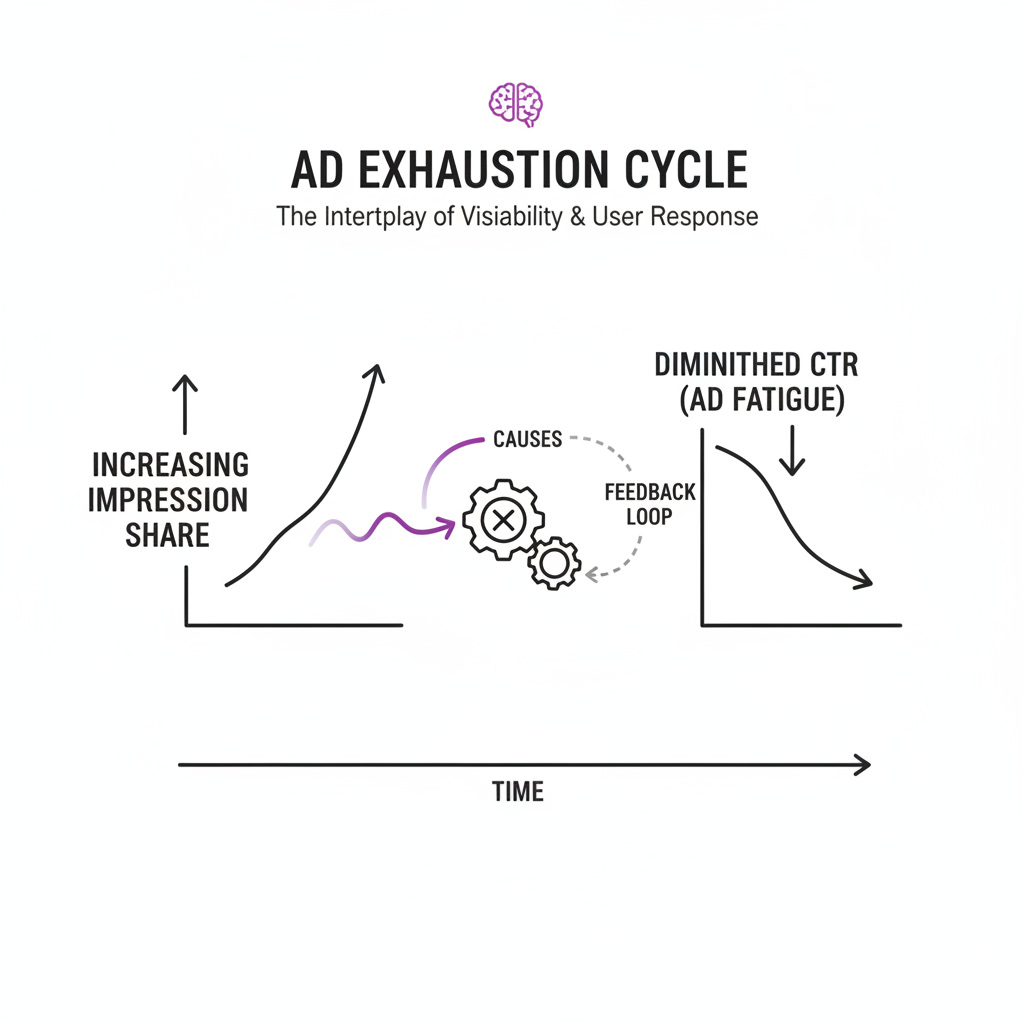
While increasing impression share is generally desirable, achieving near-100% impression share within a tight audience segment introduces a serious risk: ad fatigue.
Identifying When High Impression Share Causes Audience Burnout
When your google ads impression share reaches high thresholds (typically above 85% in Display, Remarketing, or narrow Search audiences), monitor your frequency and engagement metrics closely. The table below outlines key trade-offs when operating at varying impression share levels:
| Impression Share Level | Market Visibility | Primary Advantage | Primary Risk |
| --- | --- | --- | --- |
| 0% – 30% | Low | Low ad spend commitments | Competitors dominate search results |
| 31% – 70% | Moderate | Balanced efficiency and reach | Missed growth opportunities |
| 71% – 100% | High | Maximum market dominance | High risk of ad fatigue & diminishing returns |
Strategies to Maintain Performance at High Impression Share Levels
To sustain conversion momentum when holding dominant impression share:
- 1 Rotate Creative Assets: Regularly update headlines, descriptions, and image assets to keep messaging fresh for recurring searchers.
- 2 Expand Keyword Horizons: Introduce long-tail keywords to capture new search intents without over-saturating existing audience pools.
- 3 Implement Frequency Capping: For Display and Video campaigns, set strict daily or weekly frequency caps to prevent ad fatigue.
"Scaling impression share without creative refresh cycles inevitably leads to ad fatigue, driving up acquisition costs even as market coverage expands."
Key Takeaways for Maximizing Your Impression Share
Impression share measures market opportunity: It reveals the gap between actual ad views and total eligible opportunities.
Diagnose the cause of lost share: Identify whether losses stem from Budget (insufficient daily funds) or Rank (low bids or Quality Scores).
Quality Score directly lowers acquisition costs: Improving ad relevance and landing page experience increases rank-based impression share without increasing ad spend.
- Balance high market share with creative refreshes: Operating above 80% impression share requires active creative rotation to prevent ad fatigue and maintain audience engagement.
Let’s Uncover the Growth Hiding in Plain Sight
Navigating digital advertising metrics can feel overwhelming when dashboards only tell half the story. If you suspect your campaigns are missing out on high-intent searchers, taking a deeper look into your impression share data will show you exactly where to adjust your budget and ad rank for maximum impact.
Managing Google Ads effectively isn't about spending more—it's about making sure your business shows up precisely when your prospective customers need you most. Reach out to our team today for a comprehensive campaign audit, and let’s work together to reclaim your lost market share and turn missed opportunities into lasting revenue.
