
Social Listening: What Your Customers Are Saying When You’re Not in the Room
Quick Answer
Social listening is the strategic process of monitoring, analyzing, and interpreting online conversations across digital platforms to understand public perception of a brand or industry. Unlike basic tracking, social listening uses social media sentiment analysis to uncover actionable customer insights, helping businesses proactively improve products, customer service, and market positioning.
Understanding what your audience truly thinks about your brand often happens in conversations you were never directly invited to join. Consumers frequently discuss product experiences, customer service interactions, and industry trends on open forums, social networks, and review sites.
To tap into these candid perspectives, forward-thinking organizations look beyond direct tagging and surface-level engagement. By capturing the full scope of digital discourse, your team can turn passive mentions into practical business strategies rooted in empathy and real human connection.

What Is Social Listening and How Does It Differ From Social Monitoring?
Social listening is an active strategic framework that analyzes unstructured online conversation data to extract overarching trends, sentiment patterns, and operational insights. In contrast, standard social monitoring is a reactive tactical practice focused on answering direct customer inquiries, tracking tag notifications, and recording explicit brand mentions.
While monitoring addresses the question of what is happening on your channels, listening answers why those events occur and how your organization should adapt to better serve your community.
What are the key differences between social listening and social monitoring?
Social monitoring operates at the execution level, dealing with immediate customer service requests, brand tags, and direct messaging. Social listening operates at the analytical level, aggregating mentions across broad digital ecosystems to identify macro-trends.
Monitoring measures immediate outputs such as response times and daily ticket counts. Listening evaluates strategic outcomes, including overall brand reputation, market share changes, and shifting consumer sentiment over extended periods.
📈 Data Distribution Across Customer Feedback Channels (2024 Benchmark)
Why is social media sentiment analysis vital for modern business strategy?
Social media sentiment analysis uses natural language processing to categorize text as positive, negative, or neutral, providing context to volume spikes. Tracking mention volume alone can be misleading; a massive surge in brand mentions might indicate a successful marketing campaign, or it could signal an emerging public relations issue.
By analyzing emotional tone, businesses gain a clear picture of public perception, allowing teams to address growing concerns with compassion and clarity before they escalate.
"Data volume tells you that people are talking; sentiment analysis tells you why you should care. Knowing the emotional context changes a simple metric into a strategic roadmap."
How Can Businesses Implement Social Media Monitoring Tools Effectively?
Implementing social media monitoring tools requires defining targeted search queries, establishing baseline metrics, and building cross-functional protocols to convert unstructured online mentions into actionable operational decisions. Simply collecting data is insufficient; your business must organize and distribute insights to the teams capable of acting on them.
ℹ️ Info
When setting up monitoring queries, include common misspellings of your brand name, key executive names, product lines, and industry-specific jargon. This ensures you capture untagged conversations where raw feedback often resides.
How do you choose the right social media monitoring tools?
Selecting the appropriate platform depends on your operational scale, target platforms, and specific reporting needs. High-performing enterprise solutions offer deep historical data indexing, multi-language support, and integration with customer relationship management (CRM) systems.
When evaluating potential platforms, ensure the software can differentiate between sarcasm, regional colloquialisms, and standard sentiment. A tool should also offer custom alert thresholds so key stakeholders receive immediate notifications when negative sentiment crosses defined boundaries.
What parameters should you track to capture actionable consumer insights?
To gain meaningful clarity, your listening strategy must extend beyond basic brand queries. Focus your parameter setup on four key categories:
- 1Direct Brand Queries: Exact brand names, specific product lines, and official social handles.
- 2Competitor Benchmarks: Primary competitors' brand names, product launches, and associated campaign hashtags.
- 3Industry Terms: Non-branded sector keywords, emerging technologies, and common consumer pain points.
- 4Key Stakeholders: Names of executive leadership, prominent spokespeople, and relevant industry influencers.
Tracking these intersecting streams enables your organization to benchmark performance against industry competitors while identifying unmet market needs.
What Are the Real-World Applications of Social Listening Data?
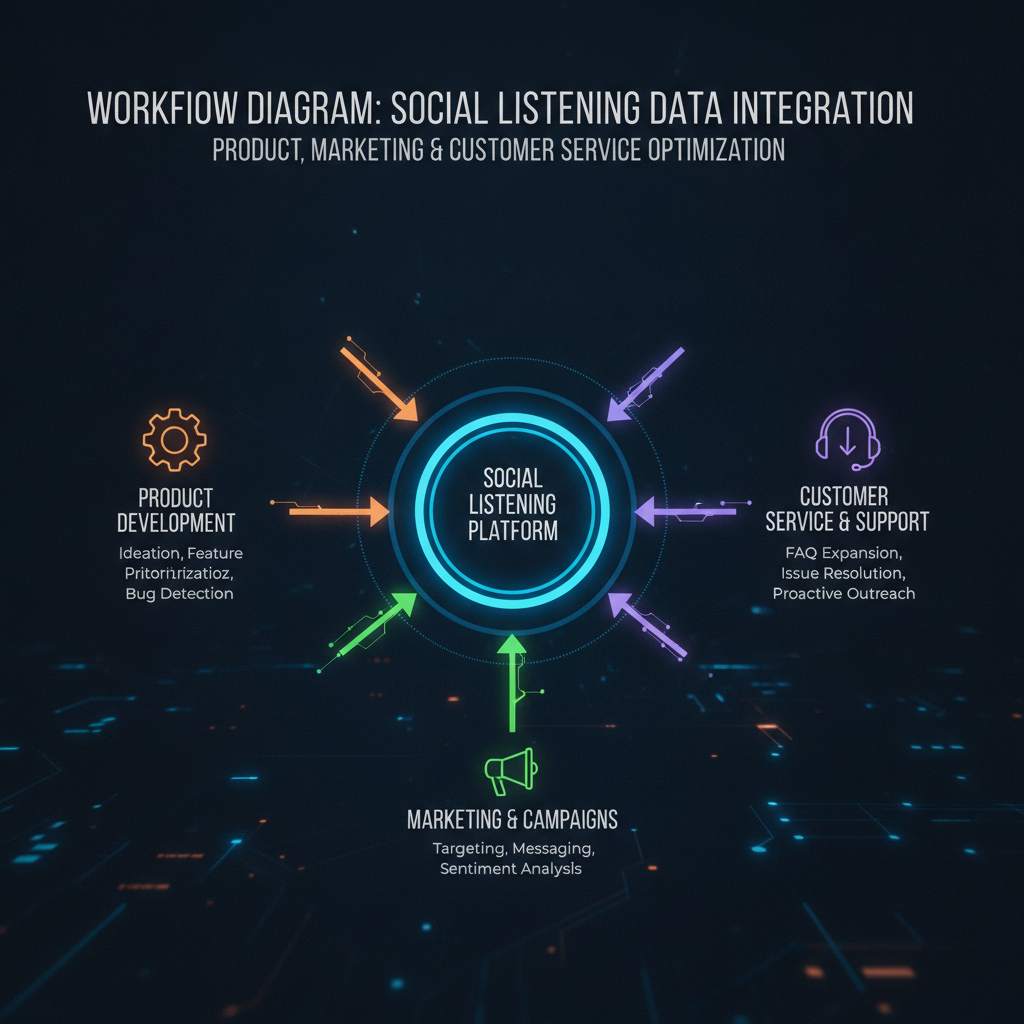
Real-world social listening applications extend far beyond marketing communications, directly informing product development, customer success, risk management, and competitive analysis. When departments share centralized listening data, organizations become vastly more agile and customer-centric.
How does social listening prevent public relations crises?
Social listening platform alerts notify communications teams the moment negative sentiment spikes beyond normal statistical variations. Early detection provides critical hours to investigate root causes, draft accurate responses, and address customer grievances before an isolated incident becomes a broader public crisis.
Based on real-world scenarios, organizations with automated sentiment alerts resolve emerging service issues up to 80% faster than those relying solely on manual customer service ticketing.
How can listening insights directly influence product development?
Unfiltered user commentary serves as a continuous, high-volume focus group. When customers experience friction with a product or service, they frequently share detailed feedback on forums, review sites, and social networks.
By systematically tagging feature requests, bug reports, and UX complaints, product teams can prioritize engineering backlogs based on real customer demand rather than internal assumptions.
📊 Business Impact of Implementing Social Listening (Industry Benchmarks)
What Are Key Takeaways for Mastering Social Listening?
Building a mature social listening program transforms raw online noise into a dependable guide for strategic decision-making.
Focus on Sentiment, Not Just Volume: High conversation numbers only provide value when contextualized through accurate sentiment analysis.
Break Down Internal Silos: Ensure listening data is shared across product development, customer care, executive leadership, and marketing.
Track Competitors Consistently: Monitoring peer performance helps identify market gaps and highlights opportunities to differentiate your services.
Proactively Protect Reputation: Early warning alerts allow your team to address negative sentiment surges before they escalate into major disruptions.
Every Conversation Holds a Story Worth Hearing
Behind every tweet, review, and forum thread is a genuine customer looking for a better experience. Truly connecting with your audience means meeting them where they are and showing that their voice actively shapes your future. By bringing true empathy into your digital intelligence, you convert raw online sentiment into meaningful, lasting customer loyalty. Connect with our team today to discover how a tailored social listening framework can uncover the human insights that elevate your brand.
