

Quick Answer
Affiliate marketing is a highly cost-effective revenue strategy for small businesses, yielding an average return of $12 for every dollar spent. By allowing independent partners to promote products via custom affiliate links, small businesses gain low-risk brand exposure and only pay commissions when actual sales occur.
Building sustainable revenue growth is a primary goal for any growing enterprise. As traditional ad costs rise across major digital advertising platforms, business owners frequently seek channel strategies that deliver measurable, performance-based results.
Implementing affiliate marketing for small business models provides a performance-driven solution. Rather than paying for impressions or clicks, business owners only invest funds when a confirmed sale occurs. This direct connection between marketing expenditure and revenue makes launching a tailored affiliate initiative one of the most reliable growth levers available today.

How Does Affiliate Marketing Work for Small Businesses?
Affiliate marketing operates as a revenue-sharing agreement between a merchant and an independent publisher. The merchant provides a commission incentive, and the partner promotes the business's products or services to their existing audience.
In practice, a small business provides partners with unique tracking links. When a consumer clicks one of these links and completes a transaction, the tracking software attributes the purchase to that specific partner, automatically calculating the earned commission.
What is the structural framework of a small business affiliate program?
A small business program relies on four fundamental components to generate recurring sales:
- 1The Merchant: The business providing the product or service.
- 2The Affiliate (Publisher): Content creators, niche bloggers, trade reviewers, or loyal customers who promote the merchant's offerings.
- 3The Tracking Platform: Software or networks that generate custom tracking links, monitor referrals, and process payouts.
- 4The Consumer: The end user who purchases the product through a publisher's link.
This lean model allows small companies to extend their market reach without expanding their internal marketing headcount.
How do custom affiliate links accurately track conversion performance?
Custom affiliate links utilize embedded parameters—typically containing individual partner IDs and cookie tracking scripts—to assign conversion credit accurately. When a consumer clicks a link, a tracking cookie is stored in their web browser for a predetermined timeframe, known as the cookie duration (commonly 30 to 90 days).
According to industry benchmarks from Impact.com, businesses utilizing dedicated affiliate management systems see an average conversion rate increase of 15% to 30% compared to unmanaged referral efforts.
If the customer completes a purchase within that active window, the system records the transaction and attributes the sale to the partner. Modern tracking solutions also support first-party data collection to ensure continuous accuracy despite evolving browser privacy standards.
📈 E-Commerce Customer Acquisition Channel ROI (2024 Benchmarks)
Is Affiliate Marketing Worth the Investment for Small Businesses?
Yes, affiliate marketing is inherently low-risk because compensation is strictly performance-based. Unlike traditional advertising—where budgets are expended regardless of outcomes—affiliate commissions are distributed only after a verified transaction occurs.
For companies operating with lean operating budgets, this structure preserves cash flow while tapping into new, highly targeted customer segments.
What are the financial and operational advantages of running an in-house program?
The financial mechanics of partner marketing inherently protect profit margins. By defining commission levels based on net margins, businesses ensure every referred sale remains profitable.
Predictable Acquisition Costs: Customer acquisition costs (CAC) are predetermined by your set commission structure.
Expanded Search and Content Visibility: Partners publish review articles, comparison guides, and social content, enhancing your web presence and domain authority.
Enhanced Social Proof: Endorsements from trusted creators carry higher trust factors than traditional corporate advertising.
What potential challenges should small business owners anticipate?
While the channel offers strong upside, successful execution requires thoughtful planning and management:
Platform Costs: Software platform subscriptions typically range between $50 and $300 per month.
Program Management Time: Onboarding creators, verifying sales, and answering publisher questions require dedicated administrative time.
Brand Safety & Compliance: Monitoring promotional activities ensures partners adhere to Federal Trade Commission (FTC) disclosure guidelines and respect brand standards.
💡 Tip
To prevent commission fraud and self-referrals, set your software parameters to require a standard 14-day or 30-day holding period before payouts are finalized. This aligns commission clearing with your customer refund policy.
How Do Small Business Programs Compare to Corporate Affiliate Programs?
Small businesses often question how they can compete with established corporate affiliate programs run by retail giants. While corporate platforms benefit from massive brand recognition, smaller enterprises offer distinct advantages that appeal directly to high-performing creators.
```
+-------------------------------------------------------------------+
| COMPARING AFFILIATE PROGRAM MODELS |
+-------------------------------------------------------------------+
| Feature | Corporate Programs | Small Business |
|--------------------|--------------------------|-------------------|
| Brand Recognition | Extremely High | Niche / Growing |
| Commission Rates | Low (Typically 1% - 5%) | High (10% - 20%+) |
| Cookie Duration | Short (24 Hours - 7 Days)| Long (30 - 90 Days|
| Partner Support | Automated / Impersonal | Direct & Personal |
+-------------------------------------------------------------------+
```
What can small businesses learn from the Target affiliate program?
The Target affiliate program (Target Circle Partners) operates on high volume, offering lower commission tiers (typically 1% to 8%) backed by short 7-day cookie windows. Because Target is a household name, conversion rates are high, but publisher margins per item remain low.
A small business cannot rely on volume alone. Instead, small programs compete by offering significantly higher commission percentages (e.g., 10% to 20% for physical goods, or 20% to 40% for digital software), longer cookie terms, and direct, caring relationships with creators.
How should small businesses structure competitive commission models?
When establishing commission tiers, evaluate your gross profit margins and lifetime customer value (LTV).
Physical Products: Standard commissions range from 8% to 15%.
Digital Products & Software (SaaS): Standard commissions range from 20% to 40%, occasionally offering recurring payouts for subscription models.
Professional Services: Fixed dollar amounts per qualified lead or completed booking (e.g., $50 to $200 per client).
📉 Affiliate Program Revenue Share Trajectory (3-Year Average)
How Do You Set Up an Affiliate Program Step-by-Step?
Launching an effective partner channel involves selecting simple tracking infrastructure, establishing fair program rules, and recruiting aligned brand champions.
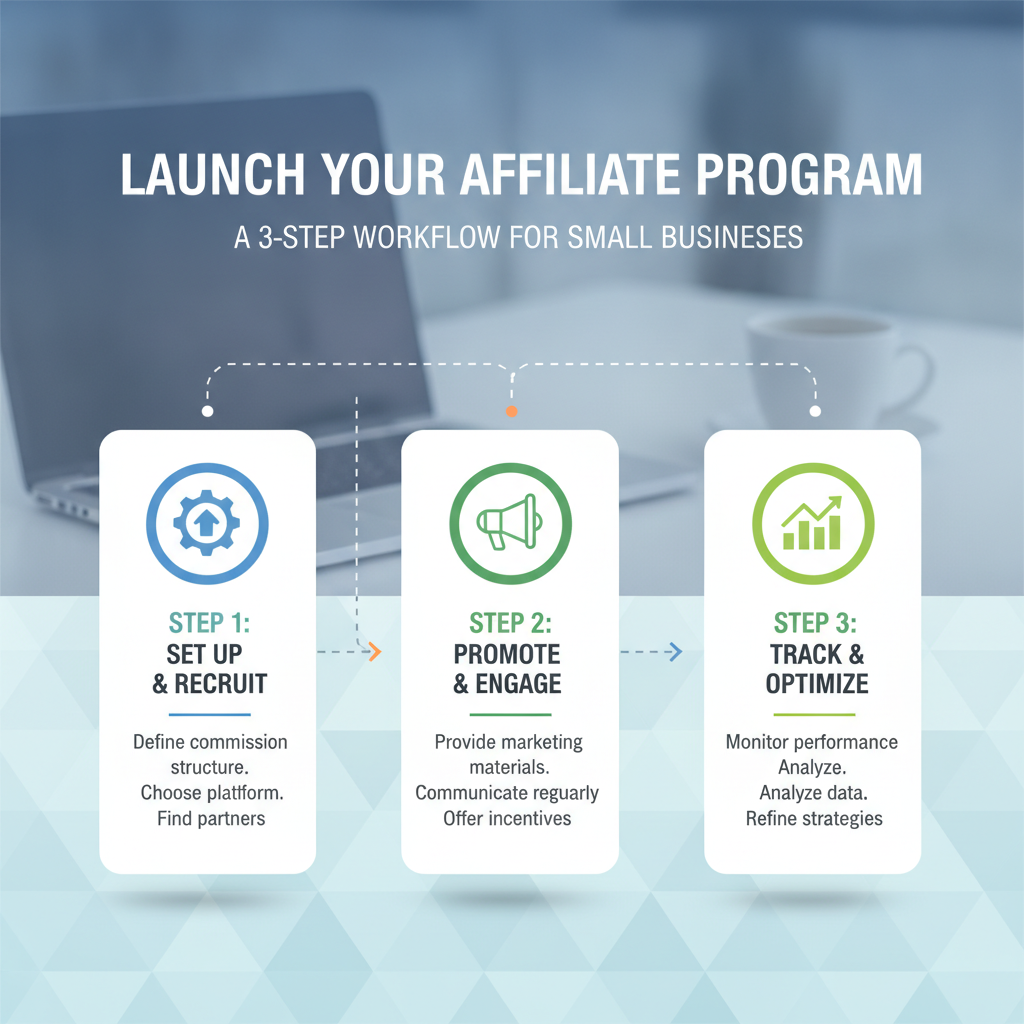
Step 1: Select the right tracking technology and software
Choose a tracking application that integrates natively with your website platform (such as Shopify, WooCommerce, or custom storefronts). Platforms like ShareASale, Refersion, or Rewardful handle link creation, attribution logic, and partner payouts automatically.
Step 2: Recruit aligned brand advocates and niche publishers
Rather than seeking thousands of inactive partners, focus on recruiting 10 to 20 active, highly relevant publishers.
Reach out to happy customers and offer them an exclusive referral link.
Contact niche content creators who review products in your industry.
Network with complementary, non-competing business owners to set up cross-promotional partnerships.
Step 3: Set clear rules and ongoing communication
Establish explicit terms of service covering paid search rules, social media FTC disclosures, and approved promotional methods. Provide your affiliates with high-quality product images, banners, and selling points to help them succeed.
Successful partner channels depend on mutual growth; treating publishers as authentic extensions of your team builds long-term commercial loyalty.
Key Takeaways for Small Businesses
Low Capital Risk: Affiliate channels require minimal upfront investment, as commissions are paid only after sales are completed.
Higher Margins Win Partners: Small businesses successfully compete with major platforms by providing higher commission percentages and personal support.
- Focus on Quality Partnerships: A small network of active, aligned creators delivers far more revenue than an unmanaged list of inactive sign-ups.
Turn Authentic Relationships into Your Most Reliable Revenue Stream
Growing a small business requires balancing big ambitions with finite resources. You don't have to navigate changing ad algorithms or rising acquisition costs in isolation. By launching an affiliate program, you cultivate a collaborative ecosystem where passionate advocates thrive alongside your brand—ensuring every marketing dollar spent directly reflects real, verifiable revenue.
Whether you're selecting your first tracking platform, establishing competitive commission tiers, or reaching out to loyal customers, taking this step can fundamentally transform how you attract lifetime buyers. Explore partner management software options today or connect with a dedicated marketing strategist to build an affiliate blueprint tailored precisely to your profit goals.
