

Quick Answers
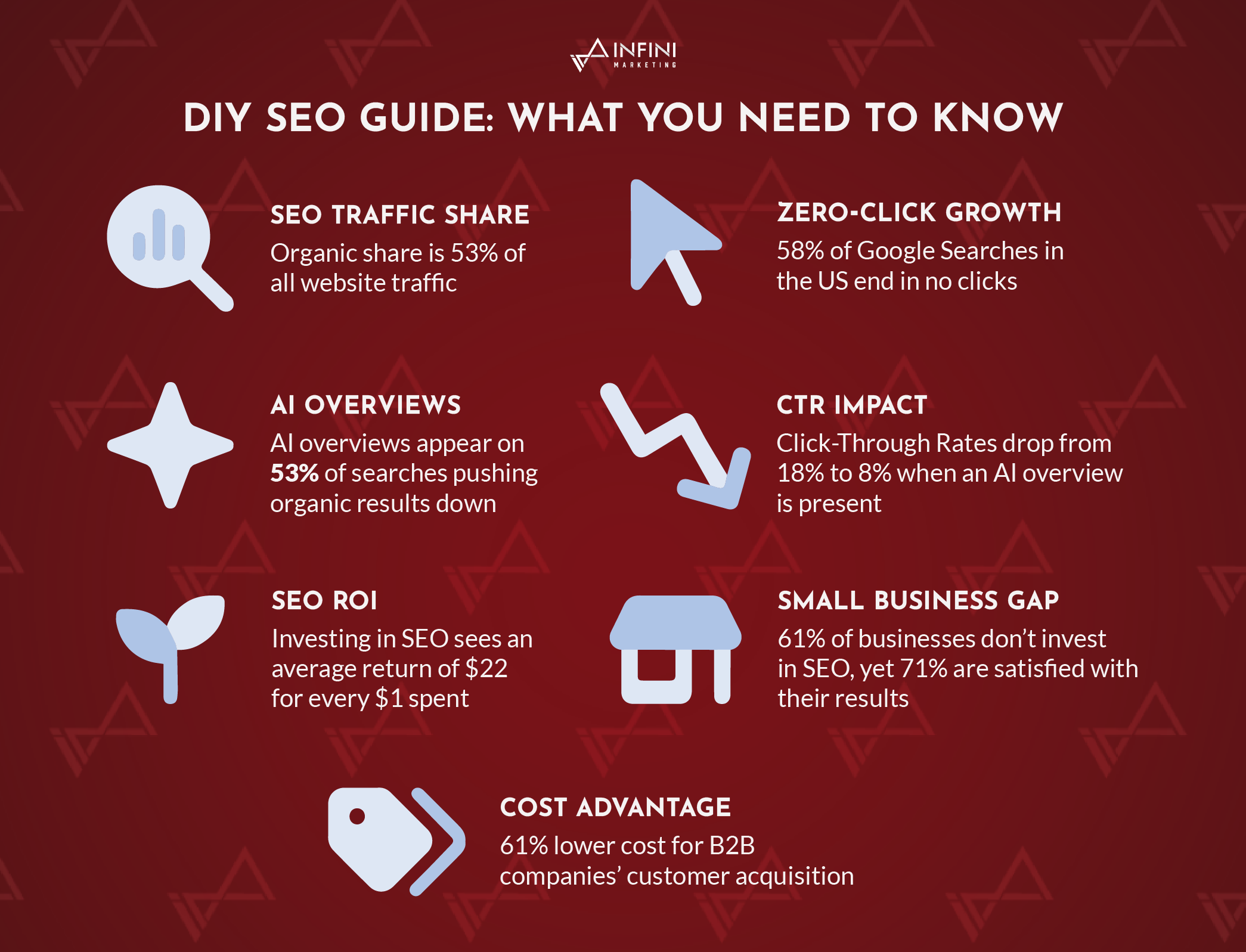
- SEO Traffic Share: Organic search accounts for 53% of all trackable website traffic, making it the single largest driver of online visibility.
- Zero-Click Growth: Over 58% of all Google searches in the U.S. now end without a click, a figure growing alongside AI Overviews.
- AI Overviews: Google's AI Overviews appear for up to 30% of U.S. desktop keywords as of September 2025, pushing organic results further down the page.
- CTR Impact: Click-through rates drop from 15% to 8% when an AI Overview is present on a results page.
- SEO ROI: Businesses investing in SEO see an average return of $22 for every $1 spent.
- Small Business Gap: 61% of small businesses are not currently investing in SEO, yet 71% of those that do report satisfaction with their results.
- Cost Advantage: B2B companies that invest in SEO acquire customers at 61% lower cost than through paid channels.
Search engine optimization is one of the most consequential decisions a business can make about its online presence. Done well, it builds authority over time, generates traffic without recurring ad spend, and compounds in value as rankings mature. Done poorly, or left unaddressed entirely, it cedes visibility to competitors who are paying closer attention.
Many business owners consider handling SEO independently, particularly in early stages when budgets are limited and information seems accessible online. The idea is understandable. However, the search environment that once made simple self-directed optimization viable has shifted fundamentally. Google's integration of generative AI into results, the growth of zero-click behavior, and the rising complexity of ranking signals have changed what effective SEO actually requires. Understanding those changes is the first step toward making an informed decision.
Can You DIY Search Engine Optimization?
Self-directed SEO is technically possible, and for businesses just starting out, some foundational work is better than none. But the gap between basic optimization and what actually moves the needle in 2026 has widened considerably. Here is what that gap looks like in practice.
What Does DIY SEO Actually Involve?
At a foundational level, SEO covers keyword research, on-page optimization, technical site health, link building, and content creation. Each of these areas can be approached using free or low-cost tools. Claiming a Google Business Profile, writing descriptive title tags, and publishing useful articles are accessible actions any business owner can take without specialized training.
The challenge is not whether a business can start. It is whether the effort invested produces returns proportional to the time spent, and whether the approach keeps pace with how search actually functions today.
Why Is Self-Directed SEO More Difficult Than It Appears?
The pace of change in search has accelerated sharply. Google's algorithms now assess experience, expertise, authority, and trustworthiness, known collectively as E-E-A-T, as core ranking signals. Publishing keyword-rich pages alone no longer produces meaningful results. Search engines have grown significantly more sophisticated in interpreting user intent through natural language processing, which means content must genuinely address what someone is looking for rather than simply containing the right phrases.
Technical requirements have expanded in parallel. Schema markup, structured data, site speed, mobile responsiveness, and internal linking architecture all contribute to how search engines understand and index a site. Each area requires ongoing attention, not a one-time setup. For a business owner already managing day-to-day operations, that level of sustained investment competes directly with everything else on the list.
What Does Inconsistent SEO Actually Cost a Business?
The cost of inadequate SEO is not always obvious in the short term, but it accumulates steadily. Organic search accounts for 53% of all trackable web traffic, meaning a site without a functional strategy is invisible to the majority of its potential online audience. Among small businesses, 61% are not currently investing in SEO at all. Yet 71% of those that do invest report being satisfied with their results. That gap reflects the difference between knowing SEO matters and having the time, knowledge, and tools to execute it at a level that produces real outcomes.
How Has AI Changed SEO?
The emergence of generative AI in search has introduced structural changes to how information surfaces on results pages. These are not minor adjustments. They represent a meaningful shift in how visibility, traffic, and user behavior interact online, and they raise the bar for what it takes to show up where it counts.
What Are Google's AI Overviews and What Do They Mean for Rankings?
Google's AI Overviews generate AI-written summaries that appear at the top of search results for certain queries. As of September 2025, these summaries appear for up to 30% of U.S. desktop keywords, up 474% on mobile year over year. When an AI Overview appears on a results page, click-through rates fall from 15% to 8%. For informational queries where a business might previously have earned traffic through a top organic listing, AI now answers the question directly. Users find what they need without visiting any website.
This pattern contributes to a broader zero-click trend: over 58% of all U.S. Google searches already end without a click to any site. Gartner projects that total search engine volume will drop 25% by 2026 as generative AI platforms absorb more queries directly.
How Does AI Change What Content Needs to Accomplish?
The pace of change in search has accelerated sharply. Google's algorithms now assess experience, expertise, authority, and trustworthiness, known collectively as E-E-A-T, as core ranking signals. Publishing keyword-rich pages alone no longer produces meaningful results. Search engines have grown significantly more sophisticated in interpreting user intent through natural language processing, which means content must genuinely address what someone is looking for rather than simply containing the right phrases.
Technical requirements have expanded in parallel. Schema markup, structured data, site speed, mobile responsiveness, and internal linking architecture all contribute to how search engines understand and index a site. Each area requires ongoing attention, not a one-time setup. For a business owner already managing day-to-day operations, that level of sustained investment competes directly with everything else on the list.
What Does AI Traffic Growth Mean for Businesses?
Traffic from large language models surged 527% year over year between early 2024 and early 2025. ChatGPT alone grew from approximately 600 referral visits per month in early 2024 to over 22,000 per month by May 2025. Visibility is no longer concentrated in a single search engine. Earning citations in AI answers, building presence on platforms like YouTube and industry publications, and optimizing for multiple discovery channels have all become part of what a functional SEO strategy requires.
For a business attempting to track and respond to this independently, keeping pace with where visibility actually comes from is a full-time undertaking.
What Are the Benefits of Working with a Marketing Agency?
The case for professional SEO is not about whether a business owner is capable of learning the basics. It is about what happens when the full scope of modern SEO is managed by a team with the tools, training, and time to do it right. A results-oriented marketing firm does not just optimize pages. It builds a system that keeps working, adapts to change, and ties every action back to measurable business outcomes.
What Role Do Social Ads Play?
Social media campaigns extend reach beyond search intent by targeting users based on demographics, interests, and behavior. Mobile formats account for 77% of all digital ad spend, reflecting where people actually spend time online. Platform selection should be driven by where target customers are most active, not by which option carries the lowest price tag.
Why Does Professional SEO Produce Better Outcomes?
B2B companies that invest in SEO acquire customers at 61% lower cost than through paid channels. That figure reflects the compounding nature of organic visibility when it is treated as a sustained investment rather than an occasional activity. Early, well-executed work continues generating traffic and leads long after the initial effort.
A marketing firm brings the tools, team, and institutional knowledge to build that foundation correctly from the start. Rather than learning through trial and error on a live site, a professional team applies tested approaches informed by current algorithm behavior, industry benchmarks, and platform-specific experience.
What Does a Marketing Firm Handle That Most Businesses Cannot Manage Alone?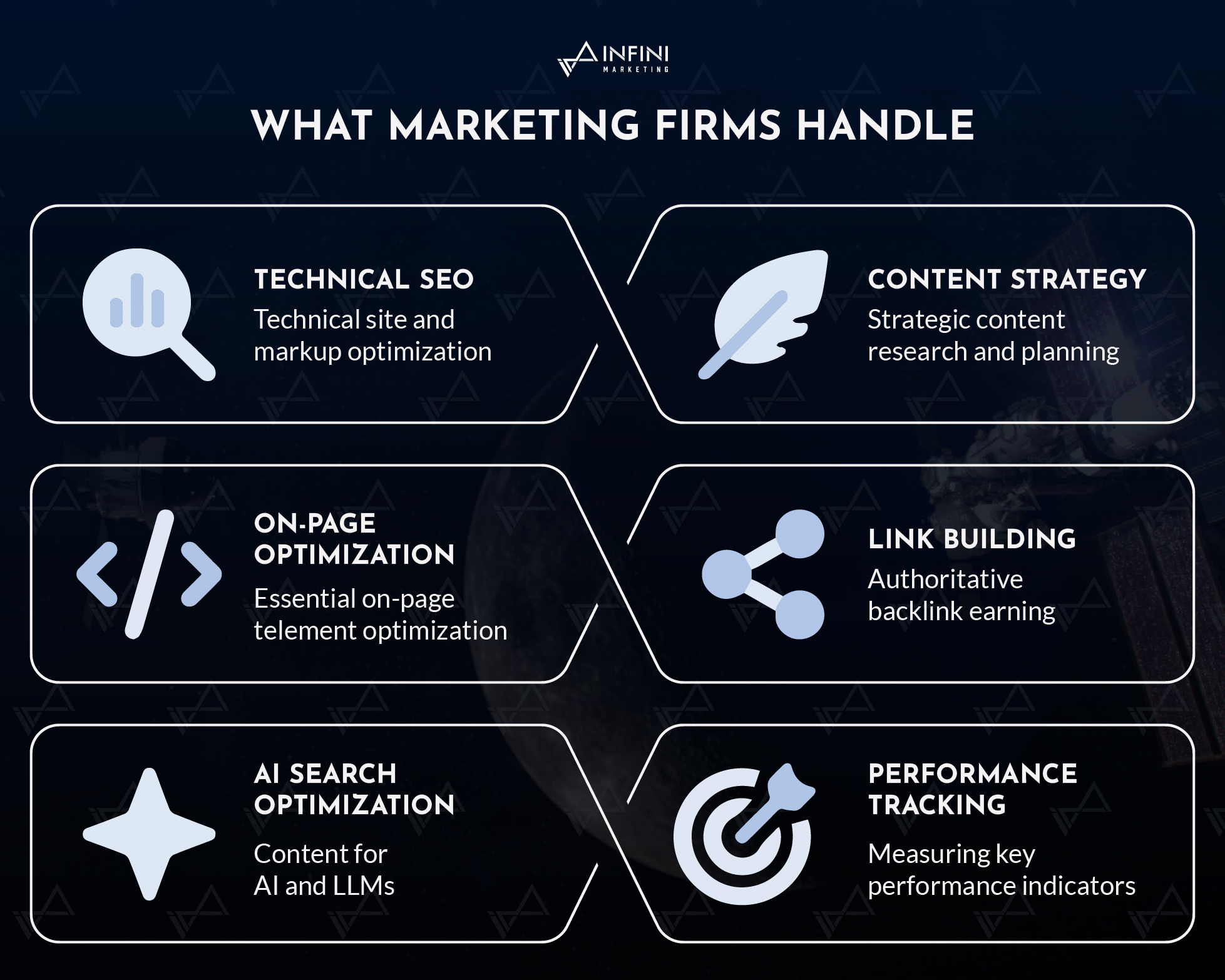
The scope of modern SEO extends well beyond publishing blog posts. A dedicated marketing firm working on a client's search presence typically covers the following areas at once:
- Technical SEO: Site speed, mobile responsiveness, crawlability, schema markup, and structured data
- Content strategy: Keyword research, topic authority, content planning, and E-E-A-T alignment
- On-page optimization: Title tags, meta descriptions, headers, image alt text, and internal linking
- Link building: Earning backlinks from authoritative, relevant sources
- AI search optimization: Structuring content to appear in AI Overviews and LLM citations
- Performance tracking: Measuring rankings, traffic, conversions, and cost per acquisition
Covering each of these areas well, while keeping pace with algorithm updates and AI developments, requires dedicated expertise and consistent attention. For most businesses, that combination is not practical to maintain without outside support.
How Has Infini Marketing Helped Clients with SEO?
Infini Marketing works with businesses across industries to build SEO strategies grounded in current search behavior. As a marketing firm focused on outcomes rather than activity, the approach is the same for every client: understand the market, identify where visibility is being lost, and build a plan that produces results that can be measured and scaled.
What Does This Look Like in Practice?
One Infini Marketing client, a professional services business with a well-established local reputation but minimal online presence, arrives at the team with a clear problem. The business does not appear in search results for the services it offers, and the volume of inbound inquiries has plateaued despite a growing market.
The Challenge
- No structured SEO strategy in place
- Website has significant technical issues preventing proper indexing
- Content does not reflect how potential clients actually search for the services offered
- No tracking or attribution to identify which efforts produce leads
The Strategy
Infini Marketing conducts a full technical audit, resolves crawlability issues, and restructures the site's content architecture around high-intent keywords relevant to the client's service area. New content addresses real search queries at each stage of the decision-making process, with proper schema markup and internal linking throughout. Performance tracking is set up to attribute leads to specific pages and search terms.
The Results
- Organic traffic increases significantly
- The business begins appearing on the first page for multiple high-priority keywords where it previously had no visibility
- Inbound lead volume grows considerably, with a notably lower cost per lead compared to prior paid efforts
- The client gains clear visibility into which content and keywords drive results, allowing the strategy to be refined further over time
The outcome reflects what structured SEO looks like when it is built on a current understanding of how search works. For this client, as for others, the difference is not just better rankings. It is a system that keeps generating qualified leads without ongoing ad spend.
What Should You Take Away From This?
SEO is not going away. Its role is changing, but organic search, AI-cited content, and structured digital visibility remain the foundation of how businesses get found online. The question is not whether to invest in SEO but how to approach it given the complexity that now surrounds it.
A business owner can learn the basics and see real improvement. But keeping pace with Google's AI integrations, algorithm shifts, and the growing number of platforms where visibility matters requires the kind of sustained, specialized effort that a dedicated marketing firm provides. The businesses that treat SEO as a strategic function rather than a periodic task build an advantage that compounds over time.

Sources
-
WordStream. (2026). 101 SEO Stats to Reference Everywhere in 2026. https://www.wordstream.com/blog/seo-statistics
-
seoClarity. (2025). Impact of Google's AI Overviews: SEO Research Study. https://www.seoclarity.net/research/ai-overviews-impact
-
Pew Research Center, cited in Position Digital. (2025). 90+ AI SEO Statistics for 2025. https://www.position.digital/blog/ai-seo-statistics/
-
Consultus Digital. (2025). SEO Cost for Small Business: Budget Guide. https://consultusdigital.com/blog/small-business-seo-budget-guide-2025/
-
HubSpot, cited in Marketing LTB. (2024). B2B SEO Statistics: 100+ Actionable Insights. https://marketingltb.com/blog/statistics/b2b-seo-statistics/
-
Previsible. (2025). 2025 State of AI Discovery Report. https://previsible.io/seo-strategy/ai-seo-study-2025/
